


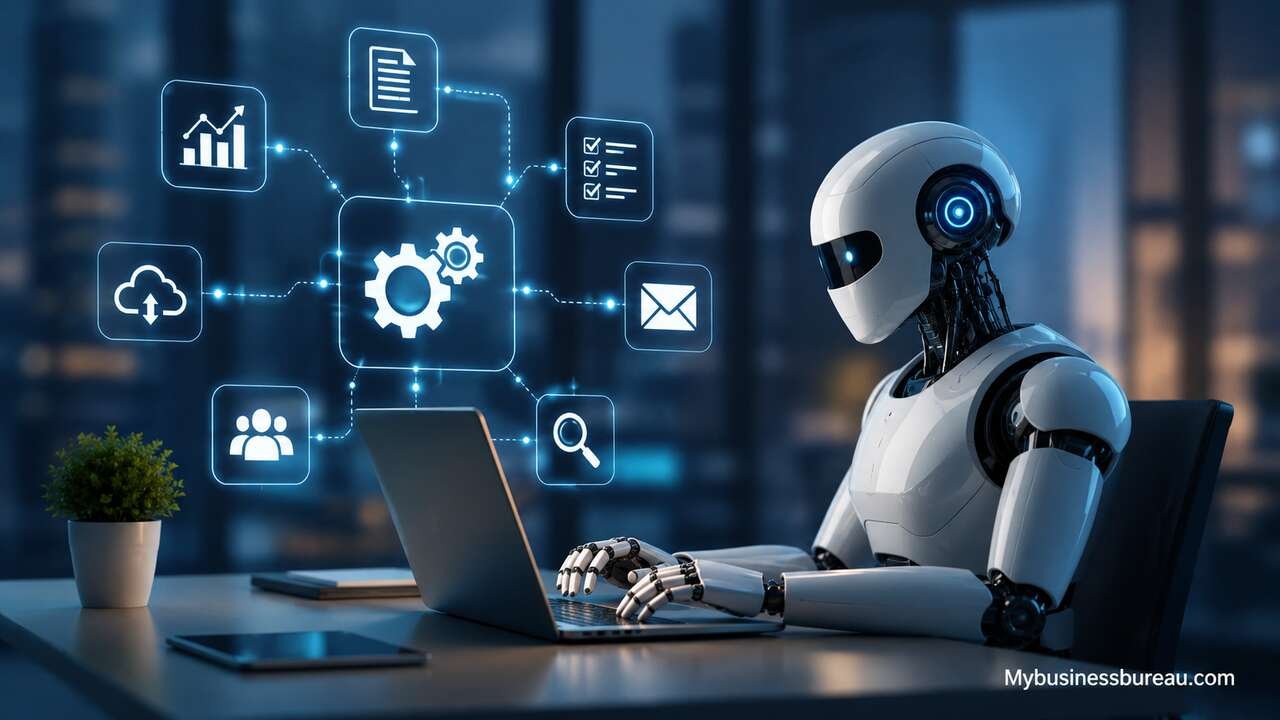
Business automation has shifted from a competitive advantage to a standard operational requirement. Companies in retail, finance, healthcare, logistics, software development, and customer support now rely on artificial intelligence to reduce repetitive work, improve decision-making, and scale operations without continuously increasing labor costs. In 2026, AI tools are no longer limited to chatbots or simple workflow automation. Modern platforms combine machine learning, natural language processing, predictive analytics, and autonomous workflows into systems that manage communication, operations, customer engagement, and data analysis in real time.
Identify Business Processes That Need Automation
The first step toward successful business automation involves identifying repetitive, time-consuming, or error-prone processes. Most organizations begin with tasks such as email management, customer support, appointment scheduling, invoicing, lead qualification, social media publishing, and reporting. These operational areas consume large amounts of employee time while producing predictable outputs that AI systems can manage efficiently.
Businesses should evaluate workflows based on volume, frequency, and operational impact. A company receiving thousands of customer inquiries every month may prioritize AI chatbots and automated support systems. A sales organization with complex pipelines may focus on AI-powered CRM automation and predictive lead scoring. Finance departments often prioritize invoice processing, payroll automation, and fraud detection.
Automation readiness also depends on data quality and software integration. AI tools perform best when connected to centralized systems such as ERP platforms, CRM software, cloud storage systems, and communication tools. Organizations that build structured workflows before implementing automation usually achieve better adoption rates and stronger operational efficiency.
| Business Function | Common Manual Tasks | AI Automation Benefit |
| Customer Support | Ticket replies, FAQs | Faster response times |
| Marketing | Email campaigns, scheduling | Personalized automation |
| Sales | Lead qualification | Higher conversion rates |
| HR | Resume screening | Faster recruitment |
| Finance | Invoice processing | Reduced accounting errors |
| Operations | Workflow tracking | Improved efficiency |
Deploy AI-Powered Customer Support Platforms
Customer service automation has become one of the most valuable AI investments for modern businesses. AI support systems now handle live chat, email routing, multilingual communication, sentiment analysis, and automated ticket escalation with minimal human intervention. These tools reduce wait times while improving customer satisfaction and operational scalability.
Platforms such as Zendesk AI, Intercom Fin AI, Freshdesk AI, and Salesforce Service Cloud AI use large language models to understand customer intent and generate contextual responses. Many systems integrate directly with knowledge bases, CRM software, and order management systems to provide personalized support without requiring human agents for every inquiry.
AI support automation also improves workforce efficiency. Human support teams can focus on complex cases while AI systems manage repetitive requests like password resets, order tracking, subscription changes, and appointment scheduling. Advanced platforms also analyze customer sentiment and prioritize urgent conversations automatically.
Leading AI Customer Support Tools in 2026
| Tool | Core Function | Best For |
| Zendesk AI | AI ticket automation | Enterprise support teams |
| Intercom Fin | Conversational AI | SaaS companies |
| Freshdesk AI | Omnichannel support | Mid-sized businesses |
| Salesforce Service Cloud AI | CRM-integrated support | Large organizations |
| Ada AI | AI customer interactions | E-commerce brands |
Many businesses combine AI chatbots with human support escalation models. This hybrid approach improves service quality while maintaining operational efficiency during high-volume periods.
Automate Sales Pipelines With AI CRM Software

Sales automation platforms have evolved into predictive intelligence systems that guide revenue operations. Modern AI CRM tools analyze customer behavior, prioritize leads, automate follow-ups, generate sales insights, and forecast revenue trends. Companies that automate sales workflows reduce administrative workload while increasing conversion opportunities.
HubSpot AI, Salesforce Einstein, Zoho CRM AI, and Pipedrive AI are among the leading sales automation platforms in 2026. These systems evaluate engagement signals such as email opens, website visits, meeting participation, and purchase intent to rank leads automatically.
AI CRM platforms also streamline communication. Automated workflows can schedule meetings, draft personalized outreach emails, update customer records, and trigger follow-up sequences based on customer behavior. This reduces the need for manual data entry and repetitive sales administration.
Businesses with long sales cycles benefit significantly from predictive analytics. AI systems identify which prospects are most likely to convert, which accounts require immediate attention, and which outreach strategies produce stronger engagement.
Key Features in AI Sales Automation Tools
- Predictive lead scoring
- Automated email sequencing
- Revenue forecasting
- Meeting scheduling
- Sales pipeline analytics
- Conversation intelligence
- CRM data enrichment
- Customer behavior tracking
Sales teams that combine automation with personalized outreach usually achieve stronger customer relationships while maintaining scalable operations.
Integrate AI Workflow Automation Platforms Across Departments
Workflow automation tools connect multiple business systems and automate operational tasks between applications. Instead of manually moving data between platforms, AI workflow systems trigger actions automatically based on conditions, schedules, or behavioral events.
Zapier AI, Make, Microsoft Power Automate, and Workato are leading workflow automation platforms in 2026. These systems integrate with CRMs, project management software, accounting tools, databases, cloud platforms, and communication applications.
A business can use workflow automation to create invoices after completed sales, notify team members about project changes, update CRM records automatically, send marketing emails after purchases, or trigger HR onboarding sequences for new employees.
AI-enhanced workflow systems now include natural language workflow creation. Users can describe operational goals in plain language, and the platform generates automation sequences automatically. This reduces technical complexity and allows non-technical employees to build automation systems.
Organizations that centralize workflow automation reduce operational fragmentation and improve consistency across departments.
Streamline Marketing Campaigns With AI Content and Analytics Tools
Marketing automation has expanded beyond email scheduling into predictive campaign management, audience segmentation, content generation, and real-time optimization. AI marketing tools now help businesses create personalized campaigns at scale while improving customer engagement.
Platforms such as Jasper, Copy.ai, HubSpot Marketing Hub AI, Adobe Sensei, and MarketMuse support content creation, SEO optimization, audience targeting, and campaign analysis. Businesses use these tools to generate blog content, social media captions, ad copy, landing pages, email campaigns, and product descriptions.
AI analytics systems monitor customer engagement patterns across websites, social platforms, and email campaigns. These insights help marketers optimize messaging, timing, and customer segmentation strategies.
Content personalization has become a major competitive advantage. AI tools analyze user behavior and dynamically adjust content recommendations, email subject lines, and product offers based on customer intent.
Marketing Automation Functions Powered by AI
| Marketing Activity | AI Capability | Business Outcome |
| Email Campaigns | Personalized messaging | Higher open rates |
| SEO Optimization | Keyword clustering | Better rankings |
| Ad Management | Bid optimization | Lower acquisition cost |
| Content Creation | AI copywriting | Faster publishing |
| Analytics | Audience insights | Improved targeting |
| Social Scheduling | Automated posting | Consistent engagement |
Businesses that combine AI-generated content with human editorial review often achieve the best balance between efficiency and brand consistency.
Improve Financial Operations With AI Accounting Software

Financial automation reduces administrative workload while improving reporting accuracy and compliance management. AI accounting systems now handle invoice processing, expense categorization, payroll management, fraud detection, cash flow forecasting, and tax preparation.
QuickBooks AI, Xero AI, Sage Intacct, and NetSuite AI are widely used business automation platforms in 2026. These tools analyze transaction patterns, reconcile accounts automatically, and identify unusual financial activity.
Invoice automation significantly improves operational speed. AI systems extract data from invoices, validate vendor details, match purchase orders, and process payments automatically. Businesses reduce processing delays while minimizing manual entry errors.
Predictive financial analytics also support strategic planning. AI models forecast revenue trends, identify seasonal cash flow fluctuations, and evaluate operational spending patterns.
Companies that automate accounting operations often improve audit readiness and financial transparency while reducing administrative costs.
Enhance Human Resources Management With AI Recruitment Tools
HR departments increasingly rely on AI to automate recruitment, employee onboarding, workforce analytics, and performance management. These tools reduce administrative burden while improving hiring speed and workforce planning.
Platforms such as BambooHR AI, Workday AI, Lever, and Greenhouse AI screen resumes, rank candidates, schedule interviews, and analyze hiring patterns. AI recruitment systems evaluate candidate skills, experience alignment, and communication patterns to support hiring decisions.
Employee onboarding automation also improves operational consistency. AI systems distribute training materials, collect compliance documents, assign equipment requests, and monitor onboarding progress automatically.
Workforce analytics tools help HR leaders identify employee engagement trends, retention risks, and productivity patterns. Predictive insights support strategic workforce planning and organizational development.
AI in HR must be implemented carefully to maintain fairness and compliance. Organizations should regularly review recruitment algorithms to avoid unintended hiring bias.
Use AI Project Management Platforms for Team Coordination
Project management automation improves collaboration, deadline tracking, and resource allocation across teams. AI-enabled project management tools now predict project risks, automate task assignments, summarize meetings, and generate workflow recommendations.
Asana AI, Monday.com AI, ClickUp AI, and Notion AI help organizations manage projects more efficiently. These systems analyze project timelines, communication patterns, and team workloads to improve operational planning.
AI meeting assistants automatically transcribe discussions, summarize action items, and assign tasks to relevant team members. This reduces communication gaps and improves accountability.
Resource forecasting also improves operational efficiency. AI systems identify workload imbalances, estimate project completion timelines, and recommend staffing adjustments based on project complexity.
Organizations managing remote or hybrid teams often benefit significantly from AI-powered coordination tools because they centralize communication and workflow visibility.
Implement AI Cybersecurity Automation Systems
Cybersecurity automation has become essential as businesses face increasing digital threats and data privacy risks. AI cybersecurity tools monitor network activity, detect anomalies, analyze threat patterns, and respond to incidents faster than traditional security systems.
CrowdStrike Falcon AI, Darktrace, SentinelOne, and Microsoft Security Copilot are among the leading cybersecurity automation platforms in 2026. These tools use behavioral analysis and machine learning to identify suspicious activity in real time.
AI-driven threat detection reduces response times significantly. Systems can isolate compromised devices, block unauthorized access attempts, and generate automated security alerts before threats escalate.
Security automation also supports compliance management by monitoring policy adherence, logging system activity, and generating audit reports automatically.
Businesses operating in regulated industries such as healthcare, banking, and e-commerce often prioritize cybersecurity automation because data protection regulations continue to expand globally.
Optimize E-Commerce Operations With AI Automation Tools
E-commerce businesses rely heavily on automation to manage inventory, customer engagement, pricing strategies, logistics, and personalization. AI tools improve shopping experiences while helping brands scale operations efficiently.
Shopify Magic, Klaviyo AI, Dynamic Yield, and Prisync support e-commerce automation in areas such as personalized recommendations, inventory forecasting, abandoned cart recovery, and dynamic pricing.
Recommendation engines analyze customer browsing behavior, purchase history, and engagement patterns to suggest relevant products. Personalized shopping experiences often increase average order value and customer retention.
Inventory management automation also improves operational efficiency. AI forecasting models predict product demand based on seasonal trends, marketing campaigns, and purchasing patterns.
Logistics automation platforms optimize shipping routes, warehouse operations, and fulfillment timing. Businesses reduce delivery delays while improving supply chain visibility.
Connect AI Assistants to Internal Business Knowledge Systems
AI assistants have evolved from simple chat interfaces into operational intelligence systems connected to internal business data. Companies now use enterprise AI assistants to retrieve documents, summarize reports, answer employee questions, and automate internal communication.
Microsoft Copilot, Google Gemini for Workspace, Slack AI, and enterprise ChatGPT integrations help organizations centralize institutional knowledge. Employees can retrieve policy information, generate reports, summarize meetings, and draft communications quickly.
AI assistants improve productivity by reducing time spent searching for information across multiple platforms. Teams can interact with operational data using conversational prompts instead of complex search processes.
Internal AI systems also support training and onboarding. New employees can ask operational questions, review procedural documentation, and access organizational knowledge through conversational interfaces.
Businesses implementing enterprise AI assistants should establish strong data governance policies to protect confidential information and maintain access control.
Evaluate AI Automation Platforms Based on Scalability and Integration
Selecting the right AI automation platform requires evaluating scalability, integration capability, security, pricing structure, and customization options. Businesses should prioritize tools that integrate smoothly with existing operational systems.
Scalability is particularly important for growing organizations. A platform that supports current operations but fails under increased workflow volume may create operational bottlenecks later.
Integration ecosystems also influence long-term efficiency. Businesses using CRM systems, accounting software, cloud storage platforms, communication tools, and ERP systems should ensure automation platforms support direct integrations or API connectivity.
Security and compliance standards remain essential evaluation factors. Organizations handling customer data, financial records, or healthcare information should verify encryption standards, audit controls, and regulatory compliance certifications.
Key Evaluation Criteria for AI Business Automation Tools
| Evaluation Factor | Importance |
| Integration Capability | Prevents operational silos |
| Scalability | Supports future growth |
| Security Standards | Protects sensitive data |
| Ease of Use | Improves employee adoption |
| Analytics Features | Supports decision-making |
| Pricing Flexibility | Controls operational cost |
| Customization | Aligns with workflows |
Businesses that test automation platforms through pilot programs often achieve smoother implementation and stronger long-term adoption.
Train Employees to Work Alongside AI Systems
Successful AI automation depends not only on software implementation but also on workforce adaptation. Employees need training to understand automation workflows, data interpretation, AI limitations, and operational oversight responsibilities.
Organizations that position AI as a productivity enhancement tool rather than a workforce replacement strategy generally experience stronger employee adoption. Teams become more receptive when automation reduces repetitive tasks and allows employees to focus on strategic responsibilities.
Training programs should include workflow management, prompt engineering, analytics interpretation, compliance awareness, and AI-assisted decision-making. Businesses that invest in digital literacy improve automation outcomes significantly.
Human oversight remains important even with advanced AI systems. Employees must review sensitive communications, validate strategic decisions, and monitor automation accuracy regularly.
Companies that combine human expertise with AI efficiency typically achieve the strongest operational performance.
Monitor Automation Performance With AI Analytics Dashboards
AI automation systems require continuous monitoring to ensure operational effectiveness. Analytics dashboards help businesses measure workflow efficiency, response times, conversion rates, cost savings, and customer satisfaction metrics.
Modern business intelligence platforms such as Tableau AI, Power BI Copilot, and Looker AI generate automated reports and predictive insights. These systems identify workflow bottlenecks, operational inefficiencies, and emerging performance trends.
Businesses should establish measurable KPIs before implementing automation. Common metrics include support resolution time, sales conversion rate, customer retention, employee productivity, processing speed, and operational cost reduction.
Continuous optimization improves long-term automation value. AI systems learn from operational data over time, allowing businesses to refine workflows, improve decision accuracy, and expand automation coverage gradually.
Organizations that regularly audit automation performance maintain stronger operational alignment and reduce the risk of inefficient processes.
Build Long-Term AI Automation Strategies for Sustainable Growth
Business automation works best when integrated into long-term operational strategy rather than isolated technology projects. Companies that develop structured automation roadmaps can scale more efficiently while adapting to changing market conditions.
A long-term strategy should prioritize operational pain points, employee training, data management, cybersecurity, and system integration. Organizations should also establish governance policies for AI usage, workflow approvals, and compliance oversight.
Incremental implementation often produces better results than large-scale operational disruption. Businesses can begin with customer support or workflow automation before expanding into predictive analytics, enterprise AI assistants, and autonomous operations.
Strategic automation planning also improves budget management. Businesses can evaluate ROI gradually while optimizing operational priorities.
Companies that treat AI automation as an evolving operational framework rather than a short-term software investment are more likely to achieve sustainable competitive advantages.
Conclusion
The best AI tools for business automation in 2026 combine operational efficiency, predictive intelligence, workflow integration, and scalable automation capabilities. Businesses across every industry now rely on AI to manage customer service, sales operations, marketing campaigns, accounting, recruitment, cybersecurity, project management, and internal collaboration.
Visit mybusinessbureau.com for expert business insights and smart growth strategies.
FAQ’s
HubSpot AI, Zapier AI, and QuickBooks AI are popular options for small businesses because they combine automation, usability, and scalable pricing structures. These platforms support marketing, workflow automation, and financial management without requiring large technical teams.
AI automation tools reduce repetitive manual tasks, accelerate workflow execution, improve decision-making, and minimize operational errors. Employees can focus on strategic work instead of administrative processes.
Most enterprise-grade AI platforms include encryption, access controls, compliance certifications, and threat monitoring systems. Businesses should still evaluate vendor security standards carefully before implementation.
AI systems primarily automate repetitive and data-driven tasks. Most businesses use AI to enhance employee productivity rather than eliminate human roles completely. Human oversight remains essential for strategic decisions and relationship management.
Retail, healthcare, finance, logistics, software development, manufacturing, and customer service industries benefit significantly from AI automation because they manage large volumes of operational data and repetitive workflows.
Businesses should begin by identifying repetitive operational tasks with measurable impact. Starting with customer support, workflow automation, or marketing automation often produces fast efficiency gains while supporting gradual AI adoption.
