






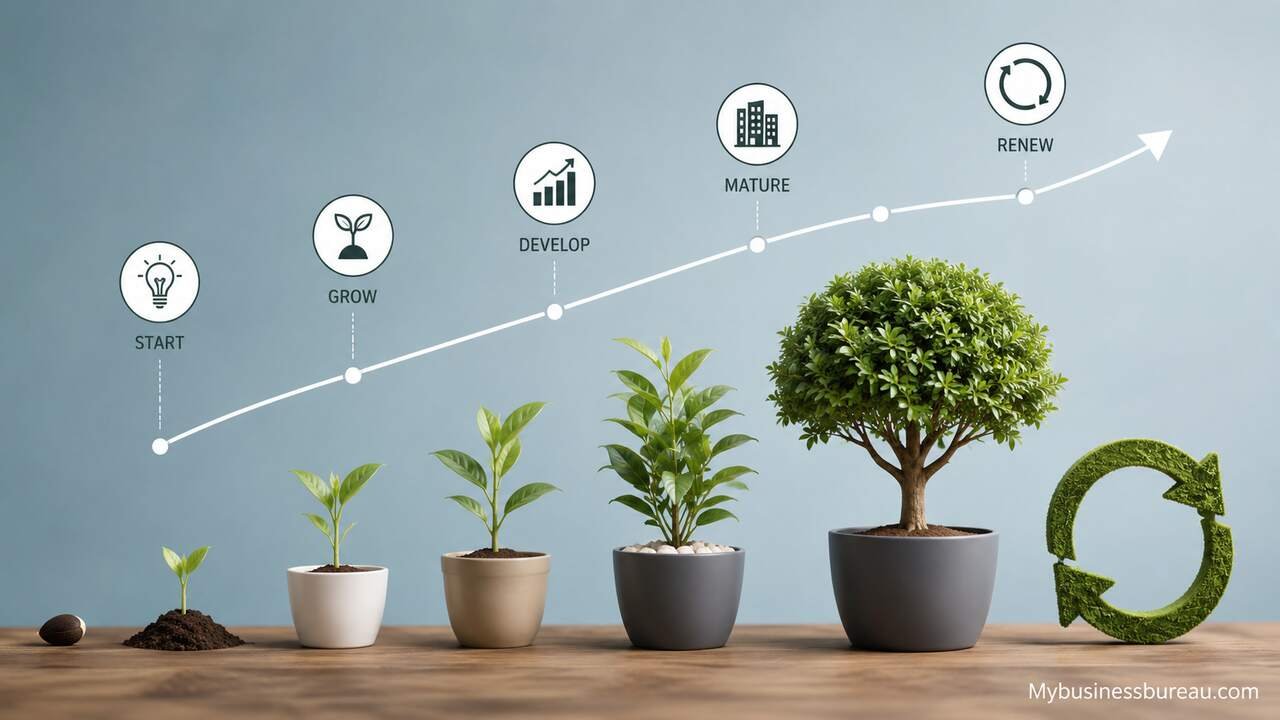
The business life cycle explains the stages a company passes through, from developing an idea and launching operations to growth, maturity, and possible decline or renewal. Understanding each stage helps business owners make better decisions about funding, marketing, operations, customers, and future growth.
Develop and Validate the Business Idea
The first step in the business life cycle is developing an idea that solves a genuine customer problem or satisfies an identifiable market need. Entrepreneurs should define the product or service, identify the intended customer, and determine why buyers would choose the proposed solution instead of available alternatives. An attractive idea becomes a viable business opportunity only when customers demonstrate sufficient interest and willingness to pay.
Market research provides the information needed to evaluate the opportunity. Business founders can study customer demographics, purchasing behavior, market size, competitors, pricing levels, distribution methods, and industry trends. Primary research may include interviews, questionnaires, observations, and product tests. Secondary research can include industry reports, government statistics, competitor information, and existing market studies.
Customer validation should follow initial research. A founder may develop a prototype, sample service, landing page, or minimum viable product to test demand. Feedback can reveal whether customers understand the offer, value its benefits, and consider the proposed price reasonable. Negative feedback at this stage can be valuable because changing an early concept usually costs less than correcting an unsuccessful product after a full launch.
The planning stage also requires an assessment of feasibility. Founders need to estimate startup costs, potential revenue, operating expenses, required skills, technology, suppliers, and regulatory obligations. These estimates do not need to predict the future perfectly. Their purpose is to determine whether the opportunity can reasonably become a functioning and financially sustainable business.
A clear value proposition connects these activities. It identifies the customer, the problem, the proposed solution, and the distinctive benefit the business delivers. Strong validation provides the foundation for every later stage of the business life cycle.
Create a Practical Business and Financial Plan


Once the idea has been validated, the next step is converting the concept into a structured business model. A business plan establishes how the company will create value, attract customers, generate revenue, manage costs, and organize operations. It also provides benchmarks against which actual performance can later be measured.
The plan should address the target market, competitive positioning, products or services, marketing strategy, sales process, operations, organizational structure, funding requirements, and financial expectations. These elements need to support one another. For example, a premium positioning strategy normally requires appropriate product quality, customer service, branding, and pricing.
Financial planning is especially important because a promising company can still fail when it runs out of cash. Founders should estimate startup investment, fixed expenses, variable costs, sales volume, gross margin, operating profit, and cash flow. A break-even calculation can show approximately how much the company must sell before revenue covers its costs.
Different scenarios can improve financial planning. A conservative scenario estimates results when sales develop slowly, while a base scenario reflects reasonable expectations and an optimistic scenario considers stronger-than-expected demand. Scenario planning helps management understand how changes in sales, pricing, expenses, or market conditions could affect the company.
| Planning Area | Main Question | Typical Output |
| Target market | Who will buy? | Customer profile |
| Value proposition | Why will customers choose the business? | Competitive positioning |
| Revenue model | How will the company earn money? | Pricing and revenue streams |
| Cost structure | What will operations cost? | Expense forecast |
| Marketing | How will customers be reached? | Marketing strategy |
| Operations | How will products or services be delivered? | Operating process |
| Finance | Can the model become profitable? | Cash flow and profit forecasts |
| Funding | How much capital is required? | Financing requirement |
A business plan should remain flexible. Actual customer behavior, costs, and competitive conditions may differ from initial assumptions. Management should therefore treat planning as an ongoing process rather than a document that becomes irrelevant after launch.
Launch the Business and Establish Market Presence
The launch stage turns planning into commercial activity. The company begins selling its product or service, serving customers, managing expenses, and building its position in the market. At this stage, survival and validation remain more important than rapid expansion because the company is still discovering whether its operating model works consistently.
Customer acquisition becomes a major priority. Depending on the business, acquisition channels may include search marketing, social media, direct sales, referrals, partnerships, physical retail, marketplaces, email marketing, or local promotion. Management should measure which channels generate qualified customers at an economically sustainable cost.
Early customers provide more than revenue. Their experiences can identify product weaknesses, service problems, confusing processes, and unmet needs. A company that systematically collects feedback can improve its offering before spending heavily on expansion. Customer complaints should therefore be treated as operational information rather than simply as negative interactions.
Cash management is particularly important during launch. Sales can increase while cash remains limited because customers may pay later than expenses become due. Inventory purchases, payroll, rent, marketing, technology, and supplier payments can create significant working-capital requirements. Monitoring cash inflows and outflows helps management detect potential shortages before they become emergencies.
Brand reputation also begins forming during this stage. Product reliability, service quality, communication, pricing transparency, and customer support influence whether early buyers return or recommend the company. Consistent delivery can convert first-time customers into repeat customers, reducing dependence on continuous acquisition.
The launch stage is successful when the company demonstrates repeatable demand, establishes workable operations, and develops enough financial stability to pursue controlled growth.
Build Consistent Revenue and Customer Retention
After establishing initial market demand, the company should focus on making revenue more predictable. Growth becomes healthier when it comes from both new customers and existing customer relationships. Businesses that constantly replace lost customers may report increasing sales while underlying retention problems weaken long-term profitability.
Customer retention depends on delivering the promised value consistently. Product quality, service reliability, support responsiveness, convenient purchasing, and effective communication all influence loyalty. Businesses should monitor repeat-purchase rates, customer complaints, churn, reviews, referrals, and customer lifetime value where appropriate.
Revenue can also become more stable through complementary products, service upgrades, subscriptions, maintenance agreements, cross-selling, or additional purchasing occasions. These approaches should solve genuine customer needs rather than simply increase transaction size. Relevant additional offers can deepen relationships while improving average revenue per customer.
Sales processes should become increasingly systematic during this stage. Early-stage founders may personally manage most sales conversations, but continued growth requires documented processes. Lead qualification, follow-up procedures, sales presentations, pricing rules, customer relationship management, and performance measurement can make results more repeatable.
Marketing should evolve in the same way. Instead of pursuing every available channel, management can compare customer acquisition cost, conversion rate, retention, revenue, and profitability across channels. Resources can then be directed toward activities that create measurable business value.
Predictable revenue gives the company a stronger platform for expansion because management can make hiring, inventory, investment, and financing decisions with greater confidence.
Scale Operations Without Losing Quality
Growth introduces a new challenge: the company must handle more customers, transactions, employees, and operational complexity without damaging the quality that created demand in the first place. Scaling means increasing capacity while preventing costs and complexity from rising at the same rate as revenue.
Standardized processes become increasingly important. Management should document recurring activities such as customer onboarding, order fulfillment, quality control, inventory management, billing, hiring, customer support, and financial reporting. Standardization reduces dependence on individual employees and makes training easier.
Technology can support efficient scaling. Customer relationship management systems, accounting software, inventory tools, project-management platforms, automation, analytics, and integrated communication systems can reduce repetitive work. Technology should solve clearly identified operational problems rather than be adopted simply because it is available.
Hiring also changes during the growth stage. A founder who initially performed marketing, sales, operations, and financial tasks eventually needs specialized employees and managers. Roles should have clear responsibilities, performance expectations, and decision-making authority. Without delegation, founders can become bottlenecks that limit growth.
Supply capacity deserves equal attention. A company selling physical products must ensure suppliers, production facilities, logistics partners, and inventory systems can support increased demand. Service companies need sufficient trained employees and scheduling capacity. Rapid sales growth can damage customer relationships when operational capacity cannot keep pace.
Management should therefore balance expansion with quality control. Sustainable scaling increases revenue while protecting customer satisfaction, margins, cash flow, and organizational stability.
Secure Funding and Strengthen Cash Flow

Companies often require additional capital as they progress through the business life cycle. Funding may be needed for inventory, equipment, employees, technology, marketing, facilities, product development, or geographic expansion. The appropriate financing method depends on the company’s stage, financial performance, ownership preferences, and risk profile.
Common funding sources include founder capital, retained earnings, bank financing, private investors, venture capital, strategic investors, and other forms of business finance. Debt allows owners to retain equity but creates repayment obligations. Equity financing can reduce immediate repayment pressure but requires owners to share ownership and potentially decision-making authority.
Cash flow should be analyzed separately from accounting profit. A profitable company can face financial distress when cash is tied up in inventory or unpaid customer invoices. Management should monitor accounts receivable, accounts payable, inventory turnover, debt obligations, operating expenses, and available cash.
Working capital management becomes particularly important during rapid growth. Consider a business that must purchase inventory 60 days before selling it but receives customer payments another 30 days later. Increasing sales can create a larger funding requirement because the company must finance the gap between paying suppliers and receiving customer cash.
Maintaining financial reserves can provide protection against unexpected expenses or temporary revenue declines. Forecasting should also be updated regularly so that management can identify financing needs early instead of searching for capital during a cash crisis.
Expand Products and Enter New Markets
Once the core business model becomes stable, management can explore additional sources of growth. Expansion may involve launching new products, entering new geographic markets, serving additional customer segments, developing new distribution channels, or acquiring complementary businesses.
Expansion decisions should be supported by evidence. A successful product in one market does not automatically succeed in another. Customer preferences, purchasing power, competitors, regulations, distribution systems, and cultural expectations can differ significantly. Market research therefore remains important even for established companies.
Product expansion should also maintain a logical relationship with customer demand and company capabilities. Existing customer data can reveal common requests, complementary needs, and purchasing patterns. These insights can help the company identify extensions that fit its established reputation.
Geographic expansion creates additional operational requirements. A business may need new suppliers, employees, warehouses, marketing strategies, legal registrations, or distribution partnerships. International expansion can introduce currency exposure, customs requirements, tax considerations, and different regulatory environments.
The company should test expansion opportunities before committing excessive resources whenever possible. Pilot programs, limited product releases, or regional tests can generate evidence about demand and economics. Controlled experimentation reduces the financial consequences of incorrect assumptions.
Optimize Performance as the Business Reaches Maturity
The maturity stage occurs when growth begins to stabilize and the business holds an established market position. Revenue may remain substantial, but the rapid percentage increases experienced during earlier stages become harder to maintain. Management priorities therefore shift toward efficiency, profitability, customer loyalty, differentiation, and capital allocation.
Operational optimization can improve margins. Management may renegotiate supplier contracts, streamline workflows, reduce waste, automate repetitive activities, improve inventory management, and analyze product-level profitability. Small efficiency improvements can create significant financial value when applied across a large organization.
Customer relationships become especially valuable in mature markets. Competitors may offer similar products, making service, trust, convenience, brand reputation, and customer experience important sources of differentiation. Loyalty programs, account management, personalization, and consistent service can strengthen retention.
The company should also evaluate its portfolio. Some products may generate strong revenue but weak margins, while others may produce reliable cash flow. Product-level analysis helps management decide where to invest, maintain, reposition, or discontinue.
| Business Life Cycle Stage | Main Objective | Common Challenge | Management Priority |
| Development | Validate the opportunity | Uncertain demand | Research and testing |
| Launch | Establish operations | Limited cash and customers | Sales and cash flow |
| Growth | Increase revenue | Operational pressure | Systems and hiring |
| Expansion | Capture opportunities | Complexity | Controlled investment |
| Maturity | Protect profitability | Slower growth | Efficiency and differentiation |
| Decline or renewal | Restore momentum | Falling relevance | Innovation or restructuring |
Maturity should not be interpreted as the end of growth. It is a signal that the company may need new strategies to create another period of expansion.
Innovate Before Growth Begins to Decline
Businesses should begin renewal efforts before declining sales make change unavoidable. Markets evolve because customer expectations, technology, regulation, competitors, and economic conditions change. A company that relies indefinitely on a previously successful model may gradually lose relevance.
Innovation can involve products, services, pricing, distribution, technology, customer experience, or the overall business model. It does not always require a revolutionary invention. A faster ordering process, improved service package, new subscription model, or more efficient delivery system can strengthen competitiveness.
Management should monitor leading indicators rather than waiting for financial decline. Falling customer engagement, weaker conversion rates, increasing acquisition costs, declining repeat purchases, changing search behavior, and competitor gains may indicate that the company’s position is weakening.
Research and development can help established companies respond to these changes. Customer interviews, employee suggestions, market analysis, competitor monitoring, and controlled experiments can generate opportunities for improvement. Innovation becomes more reliable when it operates as a continuous process instead of an emergency response.
Companies also need to protect successful operations while experimenting. Funding every new idea aggressively can create unnecessary risk. A portfolio approach allows the organization to maintain its core business while testing selected opportunities with defined budgets and performance criteria.
Restructure the Business When Performance Declines
A company enters decline when revenue, profitability, market share, or customer relevance deteriorates for an extended period. Decline can result from changing customer preferences, stronger competitors, technological disruption, excessive debt, poor execution, economic downturns, or outdated products.
Management should first diagnose the cause. Cutting expenses without understanding the problem can make matters worse. For example, reducing marketing may preserve cash temporarily but accelerate decline when insufficient customer acquisition is already the central issue.
Financial stabilization may still be necessary. Management can review unnecessary expenses, unprofitable products, inventory levels, supplier arrangements, staffing structures, debt, and underused assets. The objective is to preserve resources while creating enough flexibility to implement a recovery strategy.
Strategic options include repositioning the brand, improving products, changing prices, entering a new segment, selling non-core assets, reorganizing operations, forming partnerships, or developing a different revenue model. In severe situations, a business may consider a sale, merger, orderly closure, or other restructuring options.
Decline is not always permanent. Companies that identify the causes early and make effective changes can return to growth. Renewal effectively starts another business life cycle, with new offerings or markets creating fresh development and expansion opportunities.
Measure Business Life Cycle Performance Continuously
Business leaders should use performance indicators to determine how the company is progressing through its life cycle. Revenue alone does not provide enough information. A growing company can have weak margins, high customer churn, or unsustainable cash requirements that remain hidden behind rising sales.
Financial indicators can include revenue growth, gross margin, operating margin, cash flow, working capital, return on investment, and debt levels. Customer measures may include acquisition cost, retention rate, lifetime value, satisfaction, repeat-purchase rate, and conversion rate.
Operational measures should reflect the company’s specific business model. A retailer may track inventory turnover and order fulfillment, while a software business may focus on recurring revenue, churn, and product usage. A professional services company may monitor employee utilization, project margins, and client retention.
Metrics should be interpreted together. Rising sales combined with falling margins may indicate excessive discounting or higher input costs. Strong customer acquisition accompanied by high churn may indicate a product or service problem. Increased profit alongside deteriorating customer satisfaction could suggest that short-term cost reductions are damaging future performance.
Regular measurement allows management to identify changes earlier. The business life cycle is easier to manage when decisions are based on evidence rather than assumptions about where the company stands.
Align Leadership With Each Stage of Growth
Leadership requirements change as a company develops. During the earliest stage, founders often need creativity, speed, experimentation, and personal involvement. During growth, the organization increasingly requires delegation, process management, hiring, financial controls, and structured decision-making.
A growing business needs clear accountability. Employees should understand who owns decisions, how performance is measured, and how departments work together. Without clear responsibilities, expansion can create duplicated work, inconsistent customer experiences, and internal conflict.
Culture also becomes more important as headcount increases. Early companies often develop culture informally through founder behavior. Larger organizations need deliberate communication of expectations, values, performance standards, and management practices. Hiring decisions should consider both technical capability and the behaviors necessary for effective collaboration.
At maturity, leadership requires another shift. Executives need to protect profitable operations while encouraging innovation. Excessive risk avoidance can leave the company vulnerable to disruption, while uncontrolled experimentation can weaken a successful core business.
Strong leadership therefore adapts to the company’s current requirements. The management approach that successfully launches a business is not necessarily the same approach needed to manage a mature organization.
Prepare the Business for Long-Term Sustainability
The final objective of understanding the business life cycle is not simply to reach maturity. It is to create an organization capable of responding to change repeatedly. Long-term sustainability requires financial resilience, customer relevance, operational capability, capable leadership, and continuous adaptation.
Risk management contributes to resilience. Businesses should identify dependence on major customers, suppliers, employees, technology systems, financing sources, and geographic markets. Heavy dependence on a single source can create vulnerability when conditions change.
Succession planning can also become important as the organization matures. A company that depends entirely on its founder may struggle when that person reduces involvement. Developing managers, documenting important processes, and distributing institutional knowledge can make the organization less dependent on individuals.
Strategic planning should remain continuous. Management can periodically evaluate customer needs, competitors, industry trends, financial performance, technological changes, and internal capabilities. These reviews help the company recognize opportunities and threats before they become obvious through declining financial results.
A sustainable business does not avoid change. It develops the financial and organizational capacity to respond to change without losing control of its core operations.
Conclusion
The business life cycle provides a practical framework for understanding how companies develop, compete, grow, mature, and respond to decline. The journey generally begins with idea development and market validation, followed by launch, revenue growth, operational scaling, expansion, and maturity. When market conditions change, the company may experience decline or use innovation and restructuring to begin a new period of growth.
Each stage requires different priorities. Early businesses need validation, customers, and cash. Growing companies need systems, people, funding, and scalable operations. Mature organizations need efficiency, differentiation, innovation, and disciplined investment. Companies facing decline need accurate diagnosis and decisive strategic action.
Business owners who recognize these changing requirements can make better decisions about capital, employees, marketing, products, operations, and leadership. The greatest value of the business life cycle is therefore not predicting exactly what will happen next. It is helping leaders recognize where their business stands, identify the challenges associated with that position, and take appropriate action before conditions force the decision.
FAQ’s
The number depends on the model being used. A practical framework includes development, launch, growth, expansion, maturity, and decline or renewal. Some models combine growth and expansion or describe decline and renewal as separate stages.
There is no fixed duration. A company may progress from startup to maturity in a few years, while another may take decades. Industry growth, competition, customer demand, funding, technology, and management decisions influence the speed of progression.
The launch and early growth stages are often challenging because companies must establish demand while managing limited cash and resources. However, every stage creates different risks. Mature companies, for example, can struggle with innovation and changing customer expectations.
Management can evaluate revenue growth, profitability, cash flow, customer acquisition, retention, organizational size, market share, operational capacity, and competitive position. Looking at several indicators together provides a more reliable assessment than using company age alone.
Yes. A mature company can create renewed growth by launching new products, entering new markets, adopting new technologies, changing its business model, acquiring another company, or reaching new customer segments. Successful renewal can effectively create another growth cycle.
Not necessarily in a simple or predictable sequence. Businesses can remain mature and profitable for long periods, and companies can renew themselves before substantial decline occurs. Continuous innovation, customer research, financial discipline, and strategic adaptation can help extend a company’s competitive life.


