






Introduction
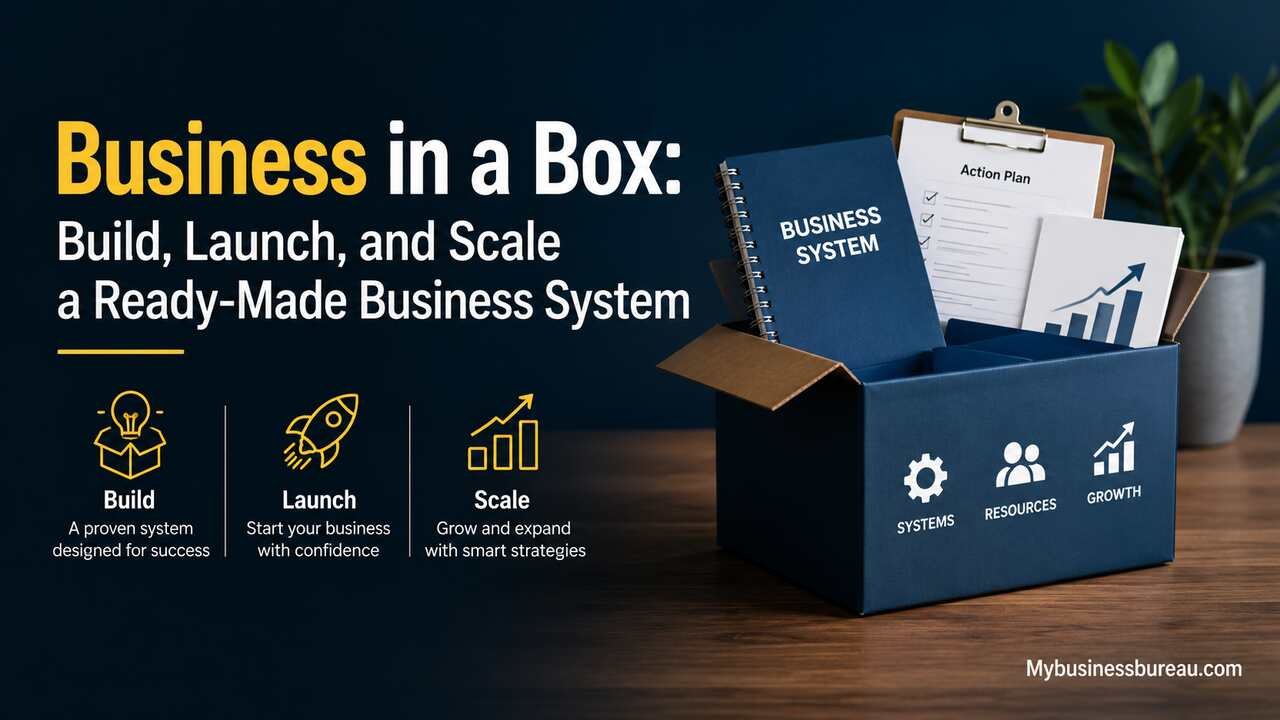
A business in a box offers a structured way to start and operate a company using prebuilt systems, processes, tools, branding elements, and operational frameworks. Instead of creating every component from scratch, entrepreneurs can use an established model that reduces setup time and simplifies execution. This approach has become increasingly popular among startups, consultants, e-commerce operators, service providers, and franchise-style businesses seeking faster market entry.
Modern business environments demand speed, consistency, and scalability. A business in a box helps meet those demands by combining operational procedures, marketing assets, technology platforms, customer acquisition strategies, and management processes into a unified package. Whether the goal is launching a digital agency, an online store, a consulting practice, or a service company, the concept allows owners to focus more on growth and less on building foundational systems.
This guide explains how to evaluate, implement, optimize, and expand a business in a box model while maintaining profitability, operational efficiency, and long-term sustainability.
Identify the Right Business in a Box Opportunity
The first step is selecting a business model that aligns with your skills, budget, interests, and market demand. A business in a box is only effective when the underlying opportunity addresses a genuine customer need and has a realistic path to profitability.
Different categories serve different goals. Digital marketing agencies often provide ready-made service packages, client onboarding systems, and lead generation frameworks. E-commerce models may include supplier relationships, product catalogs, fulfillment processes, and website templates. Service businesses can offer training manuals, scheduling systems, pricing structures, and customer support procedures.
Before making a decision, evaluate the industry, target audience, competition level, and growth potential. A model that succeeds in one market may require adjustments in another. Consider local demand, customer purchasing behavior, and regulatory requirements to determine whether the opportunity fits your circumstances.
Business in a Box Categories
| Category | Typical Components | Startup Complexity | Growth Potential |
| E-commerce | Website, products, suppliers, fulfillment | Medium | High |
| Digital Agency | Service packages, templates, CRM | Low | High |
| Consulting | Frameworks, training materials, processes | Low | Medium to High |
| Education | Courses, LMS, marketing assets | Medium | High |
| Local Services | SOPs, scheduling tools, branding | Medium | Medium |
| Subscription Business | Membership platform, content system | Medium | High |
Evaluate the Included Systems and Resources
A strong business in a box package should provide more than a logo and a website. The real value comes from the operational framework that enables consistent execution.
Look closely at the included assets. These often consist of standard operating procedures, sales scripts, marketing campaigns, onboarding processes, customer service workflows, and reporting systems. Each component should support daily operations and help reduce uncertainty.
Technology resources are equally important. Customer relationship management software, email automation tools, project management platforms, analytics dashboards, and payment processing systems can significantly influence productivity. Businesses that integrate these tools effectively tend to scale faster and maintain better customer experiences.
Pay attention to documentation quality. Detailed instructions, training materials, and implementation guides reduce learning curves and improve operational consistency. Well-documented systems make it easier to train employees and delegate responsibilities as the company grows.
Establish a Clear Business Structure
After selecting a suitable model, establish the legal and operational structure required for long-term success. Even a ready-made business system requires proper ownership, compliance, and financial management.
Choose an appropriate business structure based on your jurisdiction. Common options include sole proprietorships, partnerships, limited liability companies, and corporations. The choice affects taxation, liability protection, reporting obligations, and growth opportunities.
Financial organization should begin immediately. Separate business and personal finances by opening dedicated bank accounts and implementing accounting systems. Accurate recordkeeping improves decision-making and simplifies tax preparation.
Operational governance also deserves attention. Define responsibilities, approval processes, communication standards, and performance expectations early. These foundations help maintain consistency as the business expands.
Customize the Brand for Market Relevance


Most business in a box solutions include branding assets, but customization is often necessary to connect with the target audience. A generic identity rarely creates a lasting competitive advantage.
Start by refining the brand message. Clarify the value proposition, target customer profile, and primary benefits offered by the business. Customers should quickly understand how the company solves their problems.
Visual branding elements such as logos, color palettes, typography, and website design should align with customer expectations and industry standards. Consistent branding improves recognition and trust.
Local adaptation can further strengthen market positioning. Adjust messaging, examples, testimonials, and promotional materials to reflect regional preferences, cultural considerations, and customer priorities. Small modifications can significantly improve conversion rates.
Build an Efficient Technology Stack
Technology serves as the operational backbone of a business in a box model. The right systems automate repetitive tasks, improve visibility, and support scalable growth.
Customer relationship management platforms help organize leads, track sales opportunities, and manage customer interactions. Marketing automation tools streamline email campaigns, lead nurturing, and customer engagement activities.
Project management systems support task assignment, collaboration, and workflow visibility. Businesses that rely on multiple team members often achieve greater efficiency when standardized project processes are integrated into daily operations.
Data analytics tools provide performance insights across marketing, sales, finance, and customer service functions. Reliable data enables informed decision-making and continuous improvement.
Core Technology Components
| Function | Purpose | Key Benefit |
| CRM | Manage leads and customers | Improved sales visibility |
| Email Automation | Automate communication | Increased efficiency |
| Project Management | Organize workflows | Better team coordination |
| Analytics Platform | Track performance | Data-driven decisions |
| Accounting Software | Manage finances | Accurate reporting |
| Customer Support System | Handle inquiries | Enhanced customer experience |
Create a Repeatable Customer Acquisition Process
Customer acquisition remains one of the most important components of any business. Even the best operational systems cannot succeed without a reliable flow of new customers.
Begin by identifying acquisition channels that align with customer behavior. Common options include search engine optimization, paid advertising, social media marketing, email campaigns, referral programs, partnerships, and content marketing.
Develop a structured sales funnel that guides prospects from awareness to purchase. Each stage should have clear objectives, messaging, and performance metrics. Consistent lead nurturing increases conversion rates and improves customer relationships.
Testing and optimization should become ongoing activities. Monitor traffic sources, conversion percentages, customer acquisition costs, and return on investment. Continuous refinement often produces significant improvements over time.
Implement Standard Operating Procedures
Standard operating procedures transform a collection of tasks into a scalable business system. They create consistency, reduce errors, and simplify employee training.
Document recurring activities such as lead management, customer onboarding, service delivery, invoicing, support requests, and quality control processes. Clear documentation minimizes confusion and ensures predictable outcomes.
Procedures should be practical and easy to follow. Overly complicated instructions often decrease adoption and reduce efficiency. Focus on clarity, sequence, and measurable outcomes.
Regular updates are essential as operations evolve. Successful businesses continuously improve procedures based on experience, customer feedback, and performance data. This approach keeps systems relevant and effective.
Develop a Reliable Sales Framework
Sales processes often determine whether a business in a box generates sustainable revenue. A structured sales framework improves predictability and increases conversion opportunities.
Start by defining the customer journey. Understand the challenges, goals, concerns, and motivations influencing purchase decisions. This knowledge helps create persuasive messaging and stronger sales conversations.
Sales scripts, proposal templates, objection-handling frameworks, and follow-up sequences should support consistency. Standardized processes help maintain quality across different sales representatives and customer interactions.
Performance measurement is equally important. Track lead response times, conversion rates, average transaction values, and customer retention metrics. These indicators reveal strengths and weaknesses within the sales system.
Strengthen Customer Retention Systems
Acquiring customers is expensive compared to retaining them. A successful business in a box model includes strategies that encourage repeat purchases and long-term loyalty.
Customer onboarding plays a critical role in retention. Early experiences shape perceptions and influence future engagement. Clear communication, realistic expectations, and responsive support contribute to stronger relationships.
Regular follow-up interactions help maintain engagement. Educational content, account reviews, loyalty programs, and personalized recommendations encourage ongoing participation.
Customer feedback should guide continuous improvement efforts. Surveys, reviews, and support interactions provide valuable insights into customer needs and expectations. Businesses that actively respond to feedback often achieve higher retention rates.
Build a Team Around Proven Processes
As the business grows, owners often face capacity limitations. Expanding through hiring becomes easier when systems and procedures already exist.
Begin by identifying tasks that consume significant time but do not require direct owner involvement. Administrative work, customer support, content creation, scheduling, and data entry are common delegation opportunities.
Structured onboarding programs help new team members learn responsibilities quickly. Training resources, process documentation, and performance benchmarks accelerate productivity.
Leadership systems become increasingly important as teams expand. Clear communication channels, accountability structures, and performance evaluations support operational consistency and employee development.
Monitor Financial Performance Consistently
Financial management determines the long-term sustainability of a business in a box. Strong revenue does not automatically translate into profitability.
Track key financial indicators including revenue, gross profit, net profit, operating expenses, cash flow, customer acquisition costs, and customer lifetime value. These metrics reveal business health and support strategic planning.
Budgeting improves resource allocation and reduces unnecessary spending. Establish spending guidelines for marketing, technology, payroll, and operational expenses.
Cash flow management deserves special attention. Businesses can encounter challenges even when profitable if incoming cash does not align with outgoing obligations. Maintaining reserves helps manage fluctuations and unexpected expenses.
Expand Operations Through Strategic Scaling
One of the primary advantages of a business in a box is scalability. Systems that work effectively at a small level can often support larger operations with limited adjustments.
Scaling begins with identifying bottlenecks. Evaluate processes, staffing, technology, customer service capacity, and sales performance to determine where limitations exist.
Automation can significantly improve scalability. Marketing automation, workflow automation, customer service tools, and reporting systems reduce manual effort and increase operational capacity.
Market expansion represents another growth pathway. Businesses may enter new geographic regions, target additional customer segments, launch complementary products, or introduce premium service offerings. Each expansion should align with existing strengths and capabilities.
Protect Long-Term Competitive Advantage
Many entrepreneurs assume a business in a box guarantees success. In reality, sustainable growth requires ongoing differentiation and adaptation.
Innovation should become part of the operating philosophy. Customer expectations, technology platforms, and market conditions change regularly. Businesses that remain flexible often outperform those relying solely on their initial systems.
Brand reputation creates significant competitive value. Delivering consistent customer experiences strengthens trust and encourages referrals. Positive reputations reduce acquisition costs and improve retention.
Knowledge accumulation also contributes to long-term success. Over time, businesses develop expertise, customer insights, and operational improvements that competitors may struggle to replicate. These advantages become increasingly valuable as the organization matures.
Optimize Performance Through Continuous Improvement
Continuous improvement separates high-performing businesses from stagnant operations. Even well-designed systems benefit from regular evaluation and refinement.
Establish performance review schedules to analyze marketing effectiveness, operational efficiency, customer satisfaction, employee productivity, and financial outcomes. Regular assessments identify opportunities for improvement.
Encourage experimentation within controlled parameters. Testing pricing strategies, marketing messages, service packages, and operational workflows can reveal more effective approaches.
Documentation should evolve alongside improvements. Updated procedures ensure that new knowledge becomes part of the organization’s standard operating model. This practice helps maintain consistency while supporting growth.
Conclusion
A business in a box provides entrepreneurs with a structured framework for launching and growing a company without building every system from the ground up. By combining operational procedures, branding assets, technology platforms, sales processes, and customer management systems, this model reduces startup complexity and accelerates execution.
Success depends on selecting the right opportunity, customizing it for the target market, implementing strong operational controls, and continuously improving performance. Entrepreneurs who treat a business in a box as a foundation rather than a complete solution often achieve the best results. With effective customer acquisition, financial discipline, process optimization, and strategic scaling, a business in a box can become a sustainable and highly profitable enterprise.
Visit mybusinessbureau.com for expert business insights and smart growth strategies.
FAQ’s
No. A franchise usually operates under a specific brand with licensing requirements and ongoing fees. A business in a box typically provides systems, templates, and operational resources while allowing greater flexibility and ownership control.
Costs vary widely depending on the industry, included resources, and level of support. Some digital models cost a few hundred dollars, while comprehensive business packages can cost several thousand dollars or more.
Yes. Many solutions are designed for first-time entrepreneurs and include training materials, implementation guides, and operational templates that simplify the startup process.
Profitability depends on the business model, market demand, pricing strategy, customer acquisition effectiveness, and operating costs. Some businesses generate revenue quickly, while others require several months of development.
Digital marketing, consulting, e-commerce, education, coaching, subscription services, and local service businesses commonly use this approach because their processes can be standardized and replicated efficiently.
Yes. Many successful companies begin with standardized systems and later expand through automation, team growth, new product offerings, and market expansion. The scalability of the underlying processes often determines long-term growth potential.


