






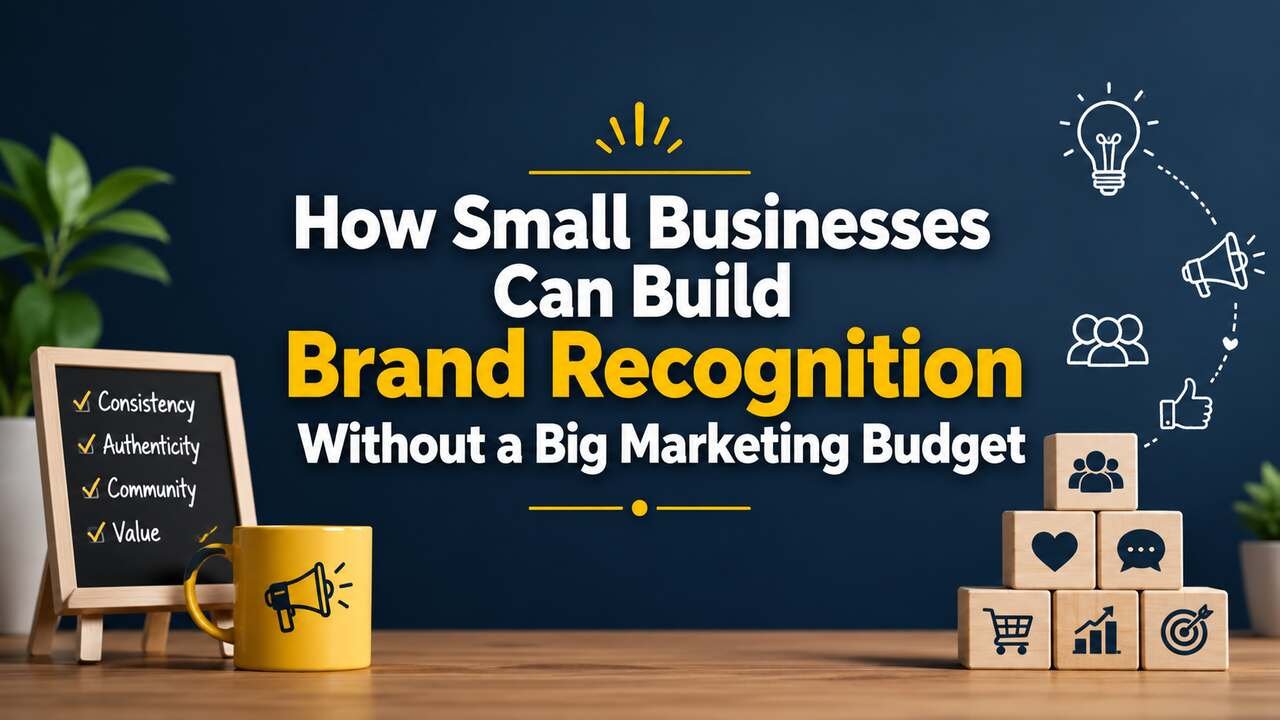
Brand recognition for small businesses is not about billboard campaigns or viral videos. It is the moment a neighbor says they know that van when yours turns into their street, or a customer tells a friend there is a brilliant little place on the high street and your name is the one that comes out. It is being top of mind before someone even starts searching. Research cited by Shine Creative shows that 59% of consumers prefer to buy from brands they already recognize, which means familiarity is doing quiet, powerful work long before a sale is even considered.
The good news is that you do not need a marketing department or an advertising budget to get there. What you need is a handful of repeatable habits applied consistently across a few well-chosen channels. This article sets out exactly how to do that: combining practical offline tactics, including community presence, memorable customer touches, and smart use of promotional products, with a handful of simple digital steps that reinforce what you are doing in the real world.


Get Clear on What You Want Your Brand to Be Known for
Before doing anything else, it helps to picture what success looks like in practical, day-to-day terms. For a small business, strong recognition shows up when customers recommend you by name without being asked, when locals spot your signage or uniform and already know what you do, or when new enquiries arrive saying they have seen you around. That kind of recall does not happen by accident; it is the result of showing up in the same way, repeatedly, in the same places.
The most useful thing you can do at the start is write down one or two specific goals. Not grow brand awareness as an abstract ambition, but something concrete: be the first plumber people in our postcode call, or have every first-time customer remember our cafe name a week later. Goals that specific make it obvious which actions are worth your time and which are not.
Then do an honest resource check. How many hours a week can you realistically spend on brand-building activity? What is a sensible monthly amount to ringfence, even if it is small? Once you know your constraints, choose one or two core audiences and two or three key messages, for example who you serve, the problem you solve, and what makes you different. Trying to appeal to everyone at once is how small businesses end up spreading their limited time across channels that produce nothing.
Consistency matters more than volume. A business that shows up in the same colours, with the same tone and the same core message across every touchpoint will be remembered far more reliably than one that does a lot but does it differently every time.
Low-cost Offline Tactics to Make Your Business Visible in the Real World
For local and community-facing businesses, offline presence still does the heaviest lifting. People trust what they encounter in their own streets, venues, and networks far more readily than something they stumbled across in a feed, and the advantage for small businesses is that most of the best offline tactics cost time rather than money.
Partnering with other local businesses is one of the most effective and underused approaches. Find businesses that serve the same kind of customer but do not compete with you: a florist and a wedding stationer, a personal trainer and a healthy cafe, a trades firm and a local estate agent. Swap flyers or counter space, co-host a short workshop, or offer each other’s customers a small discount. Each partnership puts your name in front of a warm, relevant audience at next to no cost.
Events and talks are another high-return tactic, and you do not need to organise anything elaborate. Choose one or two relevant local markets, community fairs, or business meet-ups, and prepare a single short demo or mini-talk you can re-use. Always have a simple follow-up ready, whether that is a voucher, a sign-up sheet, or a business card with a QR code. Donating a prize to a school raffle or charity auction achieves similar visibility for very little spend.
Networking works best when it is focused. Pick one regular local group, turn up with a clear one-line description of what you do and who you help, and follow up with a brief email rather than pushing for business on the night. Showing up consistently to the same group is far more effective than attending dozens of events once.
The in-person experience itself drives word of mouth more than most business owners realise. A consistent, warm greeting, a handwritten thank-you note with an order, or a small unexpected extra transforms a transaction into a story worth sharing. Make sure the physical basics are doing their job too: clear, well-placed signage, consistent use of your colours and logo, simple uniforms or name badges, and branded packaging or labels on products. These are the cues that make your business easy to spot and easy to remember.
Using Promotional Products as a Cost-effective Brand Reminder
Promotional products work for small businesses because they do something that digital content cannot: they sit in someone’s home or on their desk and keep working every time that person picks them up. A well-chosen branded item stays with the recipient for months and gets seen not just by them but by colleagues, family, and visitors, giving you repeated exposure without any ongoing spend.
The key is choosing items people will actually use. Pens, tote bags, reusable cups, notebooks, keyrings, and screen wipes all earn their place through daily visibility. Flashy but throwaway gimmicks do the opposite: they get binned quickly and leave no impression. Think about what fits your specific business and audience. A trades firm might give out a branded mini notepad or tape measure; a cafe might opt for a reusable cup or a branded coffee sleeve; a small tech support business could choose a screen-cleaning cloth with a QR code on the back. The more useful the item is to that specific person, the more it gets used and seen.
Distribution matters as much as the item itself. The highest-value moments include welcome packs for new customers, loyalty gifts after a set number of visits or purchases, low-cost thank-you gifts for referrals, and giveaways at local events where your ideal customers are already gathered. A bag of branded items at a community fair, handed only to people who have stopped to chat with you, reaches a far more relevant audience than scattering them randomly.
For promotional products to reinforce brand recognition rather than just feel like random freebies, they need to carry the same logo, colors, and strapline as everything else you use, from your signage to your website. Including a simple call to action, such as your web address, a QR code linking to an offer, or a short tagline, turns a useful object into a prompt for the next step. Understanding what promotional products are and what makes them so effective can help small businesses see more clearly how these items support recall and deliver return on investment over time.

Digital Habits That Reinforce Brand Recognition for Small Businesses
The aim online is not to be everywhere. It is to make sure that when someone who has already heard of you goes to look you up, they find something consistent, current, and reassuring. A few well-maintained digital foundations do far more for you than a scattered presence across every platform.
Start with your Google Business Profile. It is free, it directly affects whether you appear in local search results, and most small businesses have set it up but never properly maintained it. Check that the address, phone number, opening hours, and business category are all accurate, add photos that reflect the same look as your offline presence, and write a short description that mentions your location and what you do in plain language. Then make a habit of asking every happy customer to leave a review, since reviews improve both your search ranking and the confidence of people who find you.
Basic local SEO does not require an agency. On your website, include your town or area name naturally in page headings and in a clear section explaining who you serve and where. Make sure your contact details are consistent across any directories you appear in, including Yell, Yelp, and any local business listings, because inconsistency here can quietly undermine your local search visibility.
For social media, pick one or two channels based on where your specific customers already spend time. Facebook works well for local service businesses and community audiences; Instagram suits visual products and trades where before-and-after shots are natural; LinkedIn is worth the effort if you are selling to other businesses. Whichever you choose, commit to a realistic posting rhythm (twice a week is perfectly adequate) and stick to it. The best content ideas come directly from your offline activity: photos from events or talks, short tips based on questions customers regularly ask, behind-the-scenes clips, or shout-outs to partner businesses. All of this ties your online presence back to what is actually happening in your business.
An email list is the most overlooked asset for small businesses at this level. Even a list of fifty local customers is valuable. Set up a simple sign-up form on your website with a small incentive, whether that is a discount, a handy checklist, or just the promise of occasional useful updates, then send something short and genuine every few weeks: what is new in the business, a local event you are involved with, or a tip your customers would find helpful. It does not need to look like a polished campaign; it just needs to feel like it came from a real person.
Track a Few Signs, Learn, and Adjust Your Plan
Measuring whether your brand-building is working does not require dashboards or analytics software. A simple paper log or a single spreadsheet tab can tell you most of what you need to know, as long as you record the same things consistently.
The most useful signals to track are how many new customers name a specific source such as Google, a local event, or a friend’s recommendation; how often repeat customers return; whether vouchers or promo codes are being redeemed; how many email sign-ups you collect each month; and your running total of Google reviews. Each of these is easy to note in the moment, and the most powerful single habit is asking every new customer how they heard about you and writing the answer down. Over time, a clear pattern emerges about which activities are actually bringing people in.
When it is time to make changes, keep them small and one at a time. If networking is consistently bringing in referrals but your social posting is generating nothing, double down on the networking and scale back the posting rather than overhauling everything at once, and test one new idea per quarter so you can tell whether it is working. To put this into practice, take thirty minutes to sketch a one-page plan for the next quarter. Write down your one or two brand goals, choose three to five core actions mixing offline presence, promotional products, and digital habits, and list the specific signals you will watch to decide if it is working. That plan, however rough, is worth more than any strategy you do not act on.
At the end of each month, spend twenty minutes looking at those numbers. Which one or two offline activities seem to be generating the most enquiries or repeat visits? Which digital actions are driving contact? That is where your time and small budget should be going. The goal is not a perfect analysis; it is a directional read that tells you what to do more of and what to quietly drop.


