



A landscaping business offers entrepreneurs an opportunity to build a profitable company by transforming outdoor spaces into functional, attractive, and valuable environments. Residential homeowners, commercial property managers, municipalities, and real estate developers all rely on landscaping professionals to improve curb appeal, maintain healthy lawns, install outdoor features, and increase property value.
Success in the landscaping industry depends on much more than mowing lawns. Modern landscaping companies combine design expertise, horticultural knowledge, equipment management, customer service, digital marketing, and efficient business operations. Whether you are launching a solo operation or planning a large landscaping company with multiple crews, understanding every aspect of the business helps you compete effectively and build long-term profitability.
This guide explains every major step involved in starting, operating, marketing, and expanding a landscaping business while covering essential services, equipment, pricing strategies, legal considerations, customer acquisition, and growth opportunities.
Define Your Landscaping Services
Choosing the right services establishes the direction of your landscaping business. Instead of trying to provide every possible service immediately, focus on offerings that match your experience, local demand, and available equipment. Starting with a focused service list also reduces startup costs and improves operational efficiency.
Residential lawn maintenance remains one of the most consistent revenue sources. Weekly mowing, edging, trimming, fertilization, weed control, seasonal cleanup, mulching, hedge trimming, irrigation maintenance, and tree care are services that generate recurring income throughout the growing season.
Commercial landscaping provides larger contracts with office buildings, shopping centers, schools, apartment complexes, hotels, and industrial facilities. These contracts often include scheduled maintenance, landscape improvements, snow removal in colder climates, irrigation inspections, and seasonal flower installations.
Additional high-value services include:
- Landscape design
- Sod installation
- Artificial turf installation
- Hardscaping
- Retaining walls
- Patios
- Walkways
- Outdoor kitchens
- Fire pits
- Water features
- Drainage solutions
- Landscape lighting
- Tree planting
- Shrub installation
- Garden renovations
Offering seasonal services creates year-round revenue. Spring cleanups, fall leaf removal, holiday lighting installation, snow removal, and storm cleanup reduce seasonal fluctuations and keep crews productive.
Develop a Comprehensive Business Plan
A well-structured business plan serves as the foundation for sustainable growth. It outlines your objectives, financial expectations, marketing strategy, target customers, and operational procedures.
Begin by identifying your target market. Residential neighborhoods, luxury homes, commercial properties, homeowner associations, and municipal contracts each require different pricing models and marketing approaches.
Define your competitive advantage. Your company may compete through premium design services, affordable maintenance packages, environmentally friendly landscaping, rapid response times, or specialized expertise in irrigation or hardscaping.
Include detailed financial projections covering:
| Business Component | Purpose |
| Startup Costs | Equipment, licenses, insurance, marketing |
| Monthly Expenses | Fuel, payroll, maintenance, office expenses |
| Revenue Forecast | Estimated monthly income |
| Break-Even Analysis | Time required to recover startup investment |
| Profit Margins | Expected profitability by service |
Planning also includes determining staffing requirements, scheduling systems, equipment purchases, customer management software, and future expansion goals.
A strong business plan becomes increasingly valuable when applying for loans, attracting investors, or securing commercial contracts.
Register Your Business and Meet Legal Requirements
Operating legally protects your company and builds customer confidence. Registering your landscaping business ensures compliance with local regulations while providing liability protection.
Choose an appropriate business structure based on taxation, ownership, and liability considerations. Many small landscaping companies begin as sole proprietorships before transitioning into limited liability companies or corporations as they grow.
Legal requirements commonly include:
- Business registration
- Local business licenses
- Tax identification numbers
- Sales tax registration where applicable
- Contractor licensing if required
- Pesticide application certification
- Irrigation licensing
- Environmental compliance permits
Insurance remains one of the most important investments for landscaping companies.
Essential insurance includes:
- General liability insurance
- Commercial vehicle insurance
- Workers’ compensation
- Equipment insurance
- Property insurance
- Professional liability coverage for design services
Proper legal compliance reduces financial risk while demonstrating professionalism to clients.
Invest in Professional Landscaping Equipment
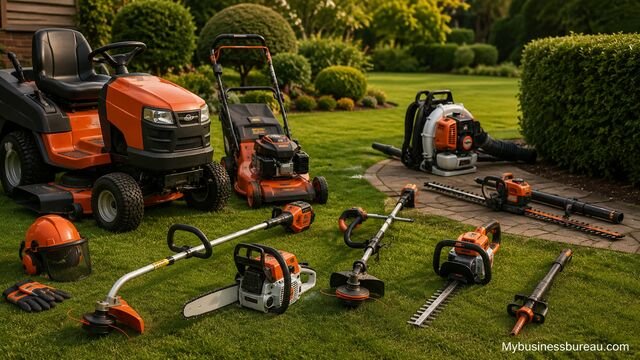
Equipment directly influences productivity, service quality, and operating costs. Purchasing reliable commercial-grade equipment often reduces long-term maintenance expenses and downtime.
Essential startup equipment includes commercial lawn mowers, string trimmers, leaf blowers, hedge trimmers, chainsaws, shovels, rakes, wheelbarrows, pruning tools, safety equipment, trailers, and work trucks.
As your company expands, additional equipment may include:
- Mini skid steers
- Excavators
- Dump trailers
- Sod cutters
- Stump grinders
- Aerators
- Dethatchers
- Power seeders
- Hydraulic lifts
- Wood chippers
- Irrigation installation tools
| Equipment | Primary Purpose | Suitable Business Stage |
| Push Mower | Small lawns | Startup |
| Zero-Turn Mower | Large residential properties | Growing business |
| Commercial Truck | Transportation | Startup |
| Trailer | Equipment hauling | Startup |
| Mini Skid Steer | Material movement | Expansion |
| Excavator | Hardscape installation | Advanced services |
Routine equipment maintenance minimizes breakdowns, improves safety, extends equipment lifespan, and protects profitability.
Build an Effective Pricing Strategy
Pricing determines both competitiveness and profitability. Charging too little limits business growth, while excessive pricing may reduce customer acquisition.
Several pricing methods are commonly used throughout the landscaping industry.
Hourly pricing works well for unpredictable maintenance work where labor requirements vary significantly.
Flat-rate pricing provides customers with certainty and simplifies quoting for standardized services.
Per-square-foot pricing often applies to sod installation, mulching, hardscaping, and irrigation projects.
Project-based pricing is commonly used for complete landscape installations involving multiple phases.
Maintenance contracts generate recurring revenue through weekly, biweekly, or monthly service agreements.
Pricing should account for:
- Labor
- Equipment depreciation
- Fuel
- Travel time
- Insurance
- Materials
- Administrative costs
- Taxes
- Desired profit margin
Regularly reviewing operating costs helps maintain healthy margins despite inflation and rising fuel prices.
Create a Strong Brand Identity
A recognizable brand helps customers remember your landscaping business and distinguishes you from competitors. Branding extends beyond a company logo and includes every customer interaction.
Choose a business name that is memorable, easy to pronounce, and relevant to landscaping. Design a professional logo that works well on vehicles, uniforms, business cards, invoices, and digital platforms.
Maintain consistent branding across all marketing materials. Uniform colors, truck wraps, employee apparel, and online profiles reinforce professionalism and improve local recognition.
A compelling value proposition should clearly communicate the benefits customers receive, such as dependable scheduling, premium workmanship, sustainable landscaping practices, or personalized outdoor designs.
Positive customer experiences strengthen your reputation and encourage referrals, which remain one of the most effective marketing channels in the landscaping industry.
Build a Professional Online Presence
Most homeowners and commercial clients begin their search for landscaping services online. A professional digital presence increases visibility, builds credibility, and generates qualified leads.
Develop a website that clearly presents your services, service areas, pricing information where appropriate, customer testimonials, completed projects, and contact details. High-quality before-and-after photos showcase your capabilities and help potential clients visualize results.
Optimize your website for local search by including location-specific service pages, relevant keywords, fast loading speeds, and mobile-friendly design. Publishing educational blog articles about lawn care, seasonal maintenance, irrigation, and landscape improvements can also attract organic traffic and establish authority.
Claim and optimize your business profiles on major online directories. Encourage satisfied customers to leave reviews, respond professionally to feedback, and keep your contact information consistent across all platforms.
Social media platforms are valuable for displaying completed projects, sharing landscaping tips, promoting seasonal offers, and engaging with local communities. Consistent posting helps maintain visibility and builds trust with prospective clients.
Conclusion
Building a successful landscaping business requires far more than owning lawn equipment and offering basic yard maintenance. Long-term success comes from developing a clear business strategy, choosing profitable services, investing in reliable equipment, hiring skilled employees, delivering exceptional customer service, and implementing effective marketing strategies. Companies that focus on quality workmanship, transparent pricing, and consistent communication are more likely to earn repeat business and valuable referrals.
As the business grows, expanding into higher-value services such as landscape design, hardscaping, irrigation systems, outdoor lighting, and seasonal property maintenance can significantly increase revenue while reducing dependence on a single service. Leveraging technology for scheduling, estimating, invoicing, and customer relationship management also improves efficiency and creates a better experience for both employees and clients.
The landscaping industry continues to grow as homeowners and commercial property owners invest in attractive, functional outdoor spaces. By maintaining high standards, adapting to changing customer needs, and continuously improving operations, a landscaping business can become a reliable source of recurring income and long-term profitability. Whether your goal is to operate a local lawn care company or build a multi-crew landscaping enterprise, careful planning and consistent execution will lay the foundation for lasting success.
FAQ’s
Startup costs vary depending on the services you plan to offer. A small lawn care business can often be launched for $5,000 to $15,000, while a full-service landscaping company that includes commercial equipment, trucks, trailers, insurance, and employees may require $50,000 or more. Costs typically include equipment, licensing, insurance, marketing, and transportation.
Yes. A well-managed landscaping business can be highly profitable due to recurring maintenance contracts, seasonal services, and high-margin installation projects. Profitability depends on efficient scheduling, proper pricing, equipment maintenance, and effective cost management. Companies that offer premium services such as hardscaping, irrigation, and landscape design often achieve higher profit margins.
Licensing requirements vary by state, province, or country. Basic lawn maintenance may require only a general business license, while services involving irrigation, pesticide application, tree removal, or large construction projects often require specialized certifications or contractor licenses. It is important to check local regulations before offering these services.
Pricing should account for labor, materials, equipment depreciation, fuel, insurance, overhead expenses, travel time, and desired profit margins. Common pricing methods include hourly rates, flat-rate packages, project-based quotes, and recurring maintenance contracts. Regularly reviewing operating costs helps ensure pricing remains competitive and profitable.
Growth typically comes from expanding service offerings, improving customer retention, investing in marketing, hiring skilled employees, adopting business management software, and pursuing larger residential or commercial contracts. Establishing recurring maintenance agreements and offering premium outdoor living solutions can also create steady revenue and support long-term expansion.
