







Business building is the process of turning an idea, product, or service into a sustainable and profitable organization. It requires a clear business model, market understanding, effective financial management, marketing, strong operations, and customer retention.
Define a Clear Business Idea and Value Proposition
Start business building by identifying a specific problem that customers need solved and determining how the business will solve it. A strong business idea connects a customer problem with a practical solution that people are willing to pay for. Instead of beginning with a broad ambition such as selling clothes, offering consulting, or developing software, define the customer, the problem, and the outcome as precisely as possible.
Develop the value proposition around the benefits customers receive. A value proposition should explain who the business serves, what it provides, and how the offer differs from available alternatives. For example, a general cleaning company may compete with hundreds of providers. A cleaning service specializing in flexible after-hours office cleaning for small medical practices has a clearer audience, service, and competitive position.
Test the idea before making major investments. Speak with potential customers, study existing competitors, review customer complaints, and evaluate buying behavior. Early testing can reveal whether customers actually experience the problem, how they currently solve it, and what they consider valuable. Business building becomes more efficient when decisions are based on customer evidence rather than assumptions.
Research the Target Market and Customer Needs
Conduct market research to understand exactly who is likely to purchase the product or service. Effective business building depends on knowing customer demographics, purchasing motivations, priorities, objections, budgets, and preferred buying channels. A company that understands its customers can develop more relevant products and communicate their benefits more effectively.
Divide the market into meaningful customer groups. For a business-to-consumer company, useful factors may include age, location, income, lifestyle, purchasing frequency, and personal priorities. A business-to-business company may segment potential customers according to industry, company size, annual revenue, location, operational challenges, or decision-maker roles. Segmentation helps the company avoid wasting resources on audiences with little purchase intent.
Combine primary and secondary research. Primary research includes interviews, questionnaires, observations, customer conversations, and product testing. Secondary research includes industry reports, government statistics, competitor websites, marketplace data, and published studies. Together, these sources help estimate demand, recognize trends, identify underserved customer groups, and understand the competitive environment.
| Research Area | Information to Identify | Business Benefit |
| Target customers | Needs, budget, behavior, location | Improves customer targeting |
| Competitors | Products, prices, strengths, weaknesses | Reveals market opportunities |
| Market demand | Search interest, buying activity, trends | Helps validate the idea |
| Customer problems | Frustrations and unmet needs | Guides product development |
| Buying process | Channels and decision factors | Improves sales strategy |
| Market trends | Growth, technology, changing preferences | Supports long-term planning |
Build a Sustainable Business Model
Create a business model that explains how the company will deliver value and generate enough revenue to remain financially sustainable. A good idea does not automatically create a successful company. The economics behind the idea must work. Revenue should eventually cover operating expenses, customer acquisition, salaries, taxes, investment requirements, and an acceptable profit margin.
Choose an appropriate revenue model. Businesses can generate income through direct product sales, subscriptions, service fees, commissions, licensing, memberships, advertising, rentals, or combinations of several models. A software company might charge a monthly subscription, while a consulting business might use fixed project fees and monthly retainers. The right model depends on customer preferences and the nature of the offer.
Analyze costs alongside revenue. Identify fixed costs such as rent, software subscriptions, insurance, and permanent salaries, as well as variable costs such as packaging, shipping, materials, transaction fees, and commissions. Understanding these numbers allows business owners to calculate margins, estimate break-even points, and determine whether the business can become profitable at a realistic sales volume.
Create a Practical Business Plan
Prepare a business plan that converts the concept into measurable objectives and operating priorities. A useful plan should describe the target market, customer problem, product or service, competitive position, marketing strategy, revenue model, operational requirements, financial expectations, and growth objectives. The plan should guide decisions rather than exist only as a formal document.
Include realistic assumptions and measurable targets. Revenue forecasts should be connected to expected customer numbers, transaction values, purchase frequency, and conversion rates. Expense projections should include both obvious and less visible costs. Marketing expenses, professional services, equipment maintenance, payment fees, taxes, insurance, refunds, and working capital requirements can significantly affect profitability.
Treat the business plan as a working document. Markets change, competitors introduce new products, customer preferences evolve, and financial performance may differ from initial projections. Reviewing the plan monthly or quarterly allows the company to compare expectations with actual performance and adjust priorities accordingly.
Establish the Legal and Financial Structure
Select an appropriate legal structure and complete the registrations required in the jurisdiction where the business operates. The available structures and terminology differ by country, but businesses commonly operate as sole proprietorships, partnerships, limited-liability structures, or corporations. The chosen structure can affect ownership, taxation, liability, reporting requirements, and the ability to raise capital.
Separate business finances from personal finances wherever appropriate. Establish suitable business banking arrangements, maintain accurate accounting records, organize receipts and invoices, and develop a system for monitoring money entering and leaving the company. Reliable records make financial decisions easier and simplify tax preparation, reporting, and financial analysis.
Consider professional guidance when legal, tax, licensing, or regulatory requirements become complex. Requirements can vary according to location and industry. Food businesses, construction companies, healthcare providers, financial businesses, importers, and other regulated operations may face additional obligations. Addressing these requirements early reduces the risk of costly compliance problems later.
Develop Products and Services Around Customer Value
Design the product or service around the result customers want rather than around features alone. Customers usually purchase an outcome such as convenience, lower costs, better performance, greater confidence, improved appearance, entertainment, or saved time. Business building becomes stronger when every important feature supports a meaningful customer benefit.
Develop a minimum viable offer when appropriate. Instead of investing heavily in a large range of products before demand is proven, begin with the smallest credible offer capable of delivering the promised result. Collect customer feedback, identify repeated problems, and improve the offer through several development cycles. This approach can reduce unnecessary spending and accelerate learning.
Quality should remain consistent as sales increase. Establish specifications for materials, production, delivery, response times, service standards, and customer support. Customers judge a company based on the complete experience, so packaging, communication, billing, delivery, returns, and after-sales service can influence the perceived value of the core product.
Create a Memorable Brand and Market Position
Build a brand that helps customers recognize, understand, and remember the business. Branding includes the company name, visual identity, messaging, tone, reputation, customer experience, and associations customers develop over time. Effective branding communicates a consistent promise instead of relying solely on logos and colors.
Define a clear market position. Determine whether the business competes primarily through specialization, convenience, premium quality, customer service, innovation, accessibility, speed, price, or another meaningful advantage. Trying to appeal to every customer often produces generic marketing. A focused position makes communication clearer and helps suitable customers understand why they should choose the company.
Maintain consistency across the website, social media, advertisements, packaging, proposals, sales conversations, and customer support. When the company repeatedly communicates the same core benefits and delivers an experience that supports those claims, customer recognition and trust can grow.
Build a Marketing System That Generates Demand

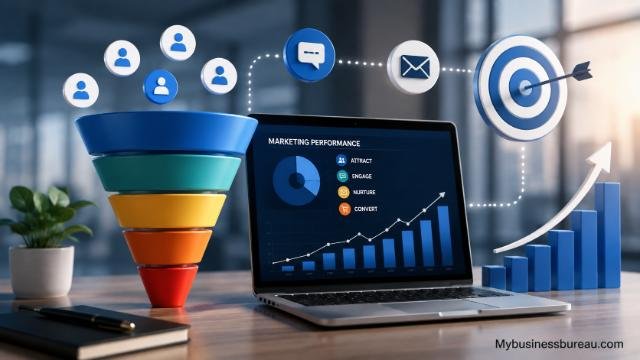
Develop a marketing system that consistently attracts qualified potential customers. Business building requires a dependable method of generating awareness and turning attention into inquiries, leads, trials, appointments, or purchases. The most effective marketing channels depend on customer behavior, industry, price point, and the complexity of the buying decision.
Use a suitable combination of search engine optimization, content marketing, email, social media, paid advertising, partnerships, referrals, events, local promotion, and direct outreach. A local service company may benefit significantly from local search visibility and referrals, while a business software company may depend more heavily on educational content, demonstrations, professional networking, and targeted outreach.
Measure performance instead of judging marketing only by impressions or followers. Track website traffic, qualified leads, conversion rates, customer acquisition costs, revenue by channel, and return on marketing investment. A channel that produces thousands of visitors but few customers may be less valuable than a smaller channel producing high-intent prospects.
Create a Repeatable Sales Process
Establish a sales process that moves potential customers from initial interest to a purchase decision. Define how leads enter the business, how quickly they receive a response, how their needs are assessed, how the offer is presented, and how follow-up occurs. A repeatable process makes sales performance easier to evaluate and improve.
Prepare for common customer questions and objections. Customers may be concerned about price, quality, timing, risk, contracts, implementation, guarantees, or comparisons with competitors. Sales conversations should address these concerns with relevant evidence rather than excessive pressure. Testimonials, demonstrations, case studies, samples, guarantees, and transparent pricing can reduce uncertainty when used appropriately.
Record sales data to identify weaknesses. If many prospects request information but few schedule consultations, the problem may occur early in the process. If consultations are frequent but purchases remain low, pricing, positioning, trust, or the offer itself may require improvement. Sales data turns a vague problem into something that can be investigated.
Manage Cash Flow and Business Finances

Monitor cash flow closely because profitable sales do not always mean that a company has enough available cash to meet immediate obligations. A business may record revenue while waiting weeks or months for customers to pay. Meanwhile, wages, suppliers, rent, marketing expenses, and other bills may require immediate payment.
Create a budget and cash flow forecast that estimates expected inflows and outflows. Review revenue, gross profit, operating expenses, accounts receivable, accounts payable, taxes, debt obligations, and available cash. Comparing forecasts with actual results allows the owner to identify problems before they become severe.
Track a focused set of financial indicators. Revenue shows sales activity, gross margin indicates the amount remaining after direct costs, operating profit reflects broader efficiency, and cash balance shows immediate financial capacity. These measurements provide different views of business health and should be considered together.
| Business Metric | What It Measures | Main Use |
| Revenue | Total sales generated | Measures sales scale |
| Gross margin | Revenue remaining after direct costs | Evaluates product economics |
| Operating expenses | Cost of running the company | Controls spending |
| Customer acquisition cost | Cost of gaining a customer | Evaluates marketing efficiency |
| Average order value | Average revenue per transaction | Identifies revenue opportunities |
| Customer retention | Customers continuing to buy | Measures loyalty |
| Cash flow | Money entering and leaving | Protects financial stability |
| Net profit | Earnings after expenses | Measures overall profitability |
Build Efficient Business Operations
Document the processes required to deliver products and services consistently. Important processes may include purchasing, inventory management, production, quality control, scheduling, order processing, invoicing, delivery, customer support, and returns. Written procedures make operations less dependent on individual memory.
Use technology where it reduces repetitive work or improves accuracy. Accounting systems can simplify financial reporting, customer relationship management platforms can organize leads, project management tools can coordinate work, and automation can reduce repetitive administrative tasks. Technology should solve a defined operational problem rather than add unnecessary complexity.
Develop contingency plans for important dependencies. A company that relies entirely on one supplier, employee, sales channel, or major customer carries concentration risk. Alternative suppliers, documented procedures, secure backups, cross-training, and diversified customer acquisition channels can make the organization more resilient.
Hire and Develop the Right Team
Hire employees or contractors when additional capacity or specialized expertise creates more value than the associated cost. Early hiring decisions have a significant impact because small teams depend heavily on individual performance. Define the responsibilities, expected outcomes, required skills, reporting relationships, and performance measures before recruiting.
Create a structured onboarding process. New team members should understand the company’s products, customers, standards, tools, workflows, responsibilities, and decision-making procedures. Clear expectations reduce confusion and help employees become productive more quickly.
As the organization expands, delegation becomes increasingly important. Founders who continue controlling every minor decision can become operational bottlenecks. Assigning ownership of defined outcomes allows managers and specialists to make appropriate decisions while leadership concentrates on strategy, major relationships, financial performance, and future growth.
Strengthen Customer Experience and Retention
Deliver a customer experience that encourages people to purchase again and recommend the company. Customer retention can strengthen business economics because existing customers already understand the brand and may require less persuasion than completely new prospects. Repeat purchases can also create more predictable revenue.
Improve every important customer interaction, including discovery, purchase, onboarding, delivery, support, renewal, and problem resolution. Establish response-time expectations, service procedures, refund or return policies, and escalation processes. When a problem occurs, fast and professional communication can significantly influence the customer’s final perception.
Collect customer feedback systematically. Reviews, surveys, support conversations, interviews, cancellation reasons, and repeat-purchase behavior can reveal strengths and weaknesses. Look for patterns rather than reacting to every individual comment. Repeated feedback often indicates opportunities to improve products, communication, pricing, or service delivery.
Measure Business Performance and Improve Results
Create a performance dashboard containing a limited number of measurements directly connected to business objectives. The appropriate indicators depend on the business model, but common measurements include revenue growth, profit margin, conversion rate, acquisition cost, average transaction value, retention rate, inventory turnover, and customer satisfaction.
Compare performance across meaningful periods and segments. A single month’s revenue figure provides limited information without comparison. Evaluate monthly and annual changes, performance by product, customer segment, location, sales representative, or marketing channel when relevant. Detailed comparisons help identify the sources of growth and decline.
Turn performance reviews into specific actions. If acquisition costs increase, analyze advertising efficiency and conversion rates. If customer retention falls, examine product quality and service issues. If margins decline, review pricing, discounts, supplier costs, and product mix. Measurement becomes valuable when it leads to informed decisions.
Scale the Business Without Sacrificing Quality
Scale only after the business has demonstrated repeatable demand and reasonably stable economics. Rapid expansion can increase revenue while simultaneously creating cash shortages, service problems, operational delays, and quality failures. Sustainable business building requires growth that the company’s systems and finances can support.
Strengthen processes before significantly increasing volume. Standardize recurring work, document important procedures, improve forecasting, automate suitable tasks, and clarify employee responsibilities. Evaluate whether suppliers, customer support, technology, fulfillment, and financial resources can accommodate higher demand.
Choose the right growth strategy for the company’s circumstances. Growth can come from selling more to existing customers, entering new locations, launching related products, targeting additional customer groups, establishing partnerships, franchising, licensing, or expanding digitally. Each method introduces different financial requirements and risks, so expansion should follow evidence rather than ambition alone.
Protect the Business Against Major Risks
Identify risks that could interrupt operations or damage financial performance. Common risks include insufficient cash, customer concentration, supplier disruption, employee turnover, legal disputes, cybersecurity incidents, regulatory changes, reputational problems, economic downturns, and changes in customer demand.
Prioritize risks according to probability and potential impact. A minor issue that occurs frequently may require a standard operating procedure, while a rare but potentially catastrophic event may require insurance, contractual protection, backup systems, or emergency planning. Risk management should focus resources where disruption would be most serious.
Review risks as the business changes. A company with ten customers faces different vulnerabilities from one with ten thousand customers. International expansion, larger teams, additional technology, new products, and increased revenue can introduce new responsibilities. Business protection should therefore develop alongside growth.
Build Long-Term Competitive Advantages
Invest in advantages that become more difficult for competitors to copy over time. A temporary discount can generate sales, but competitors can usually match it quickly. Strong customer relationships, proprietary knowledge, operational efficiency, trusted branding, specialized expertise, distribution networks, accumulated data, and superior customer experience may provide more durable differentiation.
Continue improving the company’s offer. Customer expectations and technologies evolve, so successful business building requires ongoing learning. Monitor customer behavior, competitor changes, market developments, employee feedback, and performance data. Improvements do not always require dramatic innovation. Small gains in conversion, retention, productivity, pricing, and service can compound over time.
Maintain focus while pursuing new opportunities. Businesses can weaken themselves by launching too many products, targeting too many audiences, or entering unrelated markets. Evaluate each opportunity according to customer demand, strategic fit, expected return, required investment, operational complexity, and risk. Disciplined growth can produce stronger results than expansion for its own sake.
Conclusion
Business building is a continuous process that combines customer understanding, financial discipline, effective marketing, repeatable sales, reliable operations, strong leadership, and strategic growth. A successful business begins with a valuable solution to a real customer problem, but sustainable success depends on creating systems that repeatedly deliver that value at financially viable economics.
Entrepreneurs should validate demand before making large investments, establish clear financial controls, build measurable marketing and sales processes, and continuously improve the customer experience. As the company develops, documented operations, capable employees, performance measurement, risk management, and disciplined expansion become increasingly important. The strongest approach to business building is not simply to grow quickly, but to create an organization capable of serving customers consistently, adapting to change, generating sustainable profit, and becoming stronger as it grows.
FAQ’s
Begin by identifying a specific customer problem and developing a solution people are willing to purchase. Research the market, test demand, define the business model, calculate expected costs and revenue, establish the necessary legal structure, and then launch a focused initial offer.
The amount varies significantly according to the business model. A home-based service or digital business may have relatively low startup costs, while manufacturing, restaurants, retail stores, and capital-intensive companies may require substantial funding. Calculate startup expenses, operating costs, working capital, and an appropriate financial reserve before launching.
There is no universal timeline. Results depend on the industry, market demand, competition, available capital, product quality, sales capability, and execution. Business owners should focus on measurable milestones such as customer acquisition, repeat sales, positive margins, reliable cash flow, and sustainable profitability rather than an arbitrary deadline.
Important skills include customer research, financial management, communication, sales, marketing, negotiation, decision-making, leadership, and operational planning. A founder does not need to master every specialist function, but should understand enough to evaluate performance and hire appropriate expertise when necessary.
A small business can increase customer acquisition by defining its ideal audience, strengthening its value proposition, improving search visibility, publishing useful content, developing referral programs, forming partnerships, using targeted advertising, and following up with qualified prospects. The best channels should be determined through measurable results rather than popularity alone.
A business should consider scaling after it has demonstrated consistent customer demand, repeatable sales, workable margins, dependable operations, and sufficient financial resources. Expanding before these foundations are established can magnify existing weaknesses. Strengthening the underlying systems first makes future growth easier to manage and more sustainable.


