






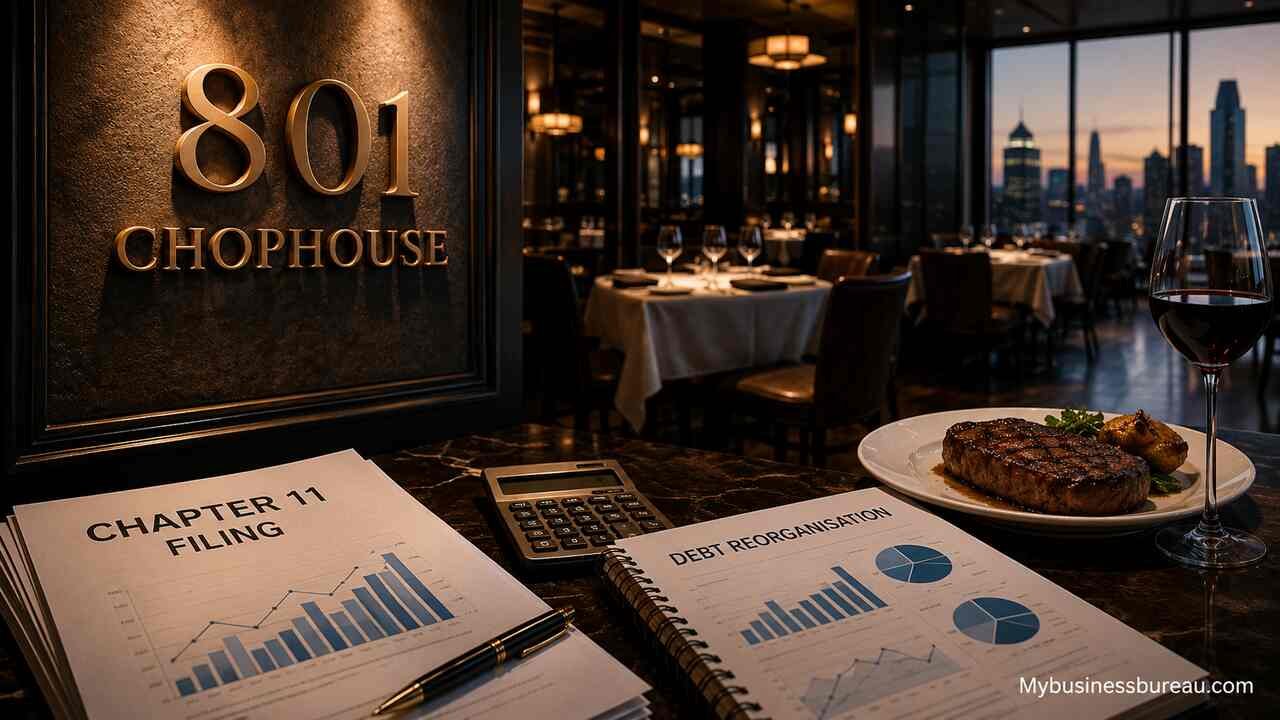
The 801 Chophouse business restructure involves a Chapter 11 filing by its parent company, 801 Restaurant Group, to reorganise debts while keeping individual restaurant locations operating. The process is intended to address financial obligations linked to closed concepts, leases, and other liabilities without automatically shutting down successful 801 Chophouse restaurants.
Review the 801 Chophouse Chapter 11 Filing
The first step in understanding the 801 Chophouse business restructure is to examine exactly which company filed for protection. On April 10, 2026, 801 Restaurant Group LLC filed a Chapter 11 petition in federal bankruptcy court in Kansas. Reports based on the filing place the company’s assets at approximately $14.9 million and its total liabilities at approximately $18.7 million.
801 Restaurant Group functions as the holding company connected with several restaurant concepts, including 801 Chophouse, 801 Fish, and 801 Local. The legal filing did not automatically place every restaurant subsidiary into bankruptcy. According to the company, the businesses directly owning and operating the restaurants were not debtors in the Chapter 11 case.
This corporate separation matters because a parent company can carry guarantees, intercompany obligations, lease commitments, and financing liabilities that differ from the day-to-day obligations of an individual restaurant. A profitable location may therefore continue trading even when its parent organisation needs to restructure debts accumulated elsewhere in the portfolio.
The filing should consequently be described as a reorganisation effort rather than a confirmed liquidation. Chapter 11 generally gives a debtor the opportunity to negotiate with creditors, revise payment arrangements, reject or modify certain burdensome agreements, and submit a plan for satisfying eligible claims.
Separate the Parent Company From Restaurant Operations
Customers evaluating the 801 Chophouse business restructure should distinguish 801 Restaurant Group from the individual companies that operate specific dining locations. The parent organisation filed for Chapter 11, but the company stated that its operating restaurant companies were not part of the bankruptcy proceeding.
This structure helps explain why reservations, dining services, gift-card use, private events, food purchasing, and employee scheduling may continue during a parent-company restructuring. Revenue generated by operating restaurants can remain connected to their respective businesses while the parent negotiates its own obligations.
The separation does not guarantee that no restaurant will ever be affected. A restructuring plan can still produce changes to management arrangements, financing, capital expenditure, supplier relationships, leases, or the composition of the wider restaurant portfolio. However, those potential outcomes should not be confused with an announcement that all 801 Chophouse restaurants are closing.
Public reporting in April 2026 indicated that existing 801 Chophouse locations would remain open and that the filing was not expected to affect normal operations. The company also stated that the successful individual restaurant businesses did not need to file for bankruptcy themselves.
Identify the Financial Pressures Behind the Restructure
The restructuring appears to be connected primarily with liabilities carried by 801 Restaurant Group, including obligations associated with restaurant concepts that had already closed. Company statements cited financial pressure linked to the closures of 801 Fish in Denver and 801 On Nicollet in Minneapolis.
The Minneapolis business had operated under the 801 Fish identity before being repositioned as 801 On Nicollet. The concept later closed after a relatively brief operating period. The Denver 801 Fish location also ceased trading. Lease commitments, guarantees, vendor claims, development expenses, and other contractual obligations can survive after a restaurant stops generating revenue.
Two major lease-related debts associated with the restructuring were reported to total more than $9.3 million. Reports also identified more than $4.2 million in unsecured claims involving 12 creditors. These figures help explain why the parent organisation selected a formal court-supervised process instead of relying only on informal negotiations.
The filing does not necessarily mean the core 801 Chophouse steakhouse concept was itself unprofitable. It indicates that the holding company’s combined liabilities exceeded the level it could comfortably manage under its existing financial structure.
| Reported financial item | Approximate amount | Significance |
| Parent-company assets | $14.9 million | Represents reported business and investment value available within the filing |
| Parent-company liabilities | $18.7 million | Shows obligations exceeding reported assets |
| Unsecured claims | More than $4.2 million | Claims that may not be supported by dedicated collateral |
| Two major lease-related obligations | More than $9.3 million | Highlights the potential effect of closed-site lease guarantees |
| Filing date | April 10, 2026 | Beginning of the formal Chapter 11 proceeding |
The figures above are based on public reporting about the initial court documents. Claim amounts and treatment can change as creditors submit documentation, claims are challenged, and the court reviews the debtor’s proposed plan.
Maintain Normal Service During the Reorganisation

A central objective of the 801 Chophouse business restructure is to preserve normal restaurant operations while the parent company addresses its debts. Chapter 11 is designed to provide breathing room from certain collection actions while a debtor develops a reorganisation strategy.
For diners, normal operations may include accepting reservations, providing regular menus, hosting private events, employing restaurant teams, purchasing ingredients, and paying routine post-filing expenses. Reports following the bankruptcy announcement stated that 801 Chophouse locations were expected to continue operating through the restructuring.
Restaurant continuity supports more than customer convenience. An open restaurant can produce cash flow, maintain employee relationships, preserve supplier partnerships, and protect the reputation attached to the 801 name. Closing successful locations without a strategic reason could reduce the enterprise value that the restructuring is intended to protect.
The company must still manage operational risk carefully. Premium steakhouses depend on consistent food quality, experienced staff, high service standards, reliable beef supplies, beverage inventory, and well-maintained dining environments. Excessive cost reductions could weaken the customer experience and reduce revenue, so management must balance financial discipline with brand preservation.
Restructure Debt and Lease Obligations
The core financial task will be to determine how 801 Restaurant Group’s liabilities should be treated. The company may seek revised repayment schedules, negotiated settlements, reduced claims, asset-based recoveries, or other arrangements permitted through the Chapter 11 process.
Lease obligations connected with closed restaurants are particularly important. A restaurant may stop operating, but a parent guarantee can leave the holding company responsible for rent, termination charges, property expenses, or other contractual amounts. When multiple unsuccessful sites create overlapping liabilities, the parent may lack sufficient cash to pay every obligation according to its original schedule.
A court-supervised restructuring creates a structured environment for addressing these claims. Creditors can file proofs of claim, the debtor can evaluate whether each amount is valid, and disputed obligations can be resolved through negotiation or judicial review.
The eventual plan must explain how different classes of creditors will be treated. Secured lenders, landlords, trade vendors, professional advisers, taxing authorities, and unsecured creditors may hold different legal rights. The available recovery for each group will depend on collateral, contractual priority, court rulings, business performance, and the value preserved through reorganisation.
Protect Profitable 801 Chophouse Locations
Management’s strongest restructuring asset may be the continuing performance of established 801 Chophouse restaurants. The brand has operated since the early 1990s and is associated with premium steaks, USDA Prime beef, Wagyu selections, seafood, wine, cocktails, and traditional fine-dining service.
Established locations can contribute recurring revenue, local recognition, experienced management teams, customer loyalty, event bookings, and supplier purchasing volume. These qualities can support the company’s argument that the operating portfolio has greater value as a functioning restaurant network than it would have through piecemeal liquidation.
Protection may involve reviewing the performance of every site individually. Management can compare revenue, food cost, labour cost, occupancy expense, average guest spending, reservation demand, private dining sales, and local competition.
A profitable restaurant with a sustainable lease may remain an important part of the post-restructuring group. A location with weak margins, excessive rent, declining demand, or major capital requirements may require renegotiation or a different strategy. No particular closure should be assumed unless the company or court record confirms it.
| Operating area | Restructuring priority | Desired result |
| Core steakhouse locations | Preserve profitable operations | Maintain cash flow and brand value |
| Closed restaurant leases | Negotiate or reorganise guarantees | Reduce long-term financial pressure |
| Supplier relationships | Keep essential accounts stable | Protect menu consistency and inventory |
| Labour and management | Retain skilled employees | Maintain service quality |
| Capital spending | Prioritise essential projects | Preserve cash without damaging operations |
| Growth planning | Limit poorly supported expansion | Prevent new liabilities during recovery |
Strengthen Cash Flow and Cost Controls
Successful reorganisation requires more than reducing old debts. 801 Restaurant Group must also ensure that continuing operations generate enough cash to support current expenses and the obligations included in a future restructuring plan.
Restaurant cash flow depends on sales volume, menu pricing, food costs, labour productivity, occupancy expenses, credit-card fees, utilities, insurance, repairs, marketing, and administrative overhead. Fine-dining operators face particular exposure to premium-protein prices because beef represents a significant component of the guest experience.
Management can respond by refining menu engineering rather than applying indiscriminate cuts. Popular and profitable dishes can receive greater visibility, portion specifications can be standardised, waste can be measured, and purchasing agreements can be reviewed. Price increases may be necessary, but they must remain consistent with the experience customers expect from an upscale steakhouse.
Labour controls also require balance. Reducing staff too aggressively can lengthen service times and weaken hospitality. A more sustainable approach aligns scheduling with reservation patterns, private-event demand, seasonal traffic, and local dining habits while protecting key culinary and service roles.
Central overhead should receive similar scrutiny. The parent company can review executive expenses, consulting arrangements, software contracts, insurance coverage, administrative duplication, and expansion-related costs. Savings at the holding-company level may be less visible to customers and therefore less damaging to the restaurant experience.
Reassure Employees, Customers, and Suppliers
Clear communication is essential during the 801 Chophouse business restructure. Bankruptcy headlines can create uncertainty even when individual restaurant companies remain outside the filing.
Employees need timely information about payroll, benefits, scheduling, leadership responsibilities, staffing plans, and the status of their specific location. Uncertainty can encourage experienced chefs, servers, bartenders, managers, and event professionals to seek other employment. Losing those employees could damage service quality when operational stability is most important.
Customers need confirmation that restaurants are open, reservations remain valid, events will proceed, and accepted payment or promotional programmes continue to function. The company should communicate only what it can verify, especially when discussing gift cards, deposits, loyalty benefits, or long-term event agreements.
Suppliers require assurance that post-filing orders will be authorised and paid according to agreed terms. Premium steakhouse operations depend on dependable relationships with meat distributors, seafood providers, wine and spirits suppliers, produce vendors, linen services, maintenance companies, and technology providers.
Landlords also need location-specific information. A restaurant that remains productive can support the value of a commercial property, while a dispute over a closed site may require separate negotiation. Treating every landlord relationship in the same way would overlook major differences between successful locations and legacy liabilities.
Monitor Court Filings and Creditor Negotiations
The initial bankruptcy petition marks the beginning of the process rather than its conclusion. Stakeholders should monitor official court developments instead of relying solely on the first round of headlines.
Important filings may include schedules of assets and liabilities, statements of financial affairs, creditor claims, motions concerning ordinary business operations, requests involving professional advisers, lease decisions, financing arrangements, disclosure statements, and the proposed reorganisation plan.
The claims process may alter the amounts originally reported. A landlord might submit a higher claim than the debtor expects, the company might dispute part of that claim, or the parties might negotiate a settlement. Likewise, asset values can change based on updated appraisals, restaurant performance, ownership interests, and market conditions.
A reorganisation plan generally describes how the debtor intends to emerge from Chapter 11. It may include extended repayment periods, reduced obligations, asset sales, new capital, amended ownership rights, operational reforms, or negotiated settlements.
Until the court confirms a plan, reports about permanent outcomes should be treated cautiously. The confirmed facts are that 801 Restaurant Group filed for Chapter 11 on April 10, 2026, that approximately $18.7 million in liabilities was reported, and that the company said the operating restaurant businesses were expected to continue normally.
Evaluate the Effect on 801 Chophouse Locations
The immediate effect on 801 Chophouse restaurants appears limited because the operating companies were not included in the parent’s bankruptcy case. Customers could continue making reservations, and the group stated that the restructuring was not expected to affect the remaining locations.
The longer-term effect will depend on financial performance and the terms of the approved restructuring plan. Strong restaurants with sustainable leases and reliable customer demand are more likely to support the reorganised company. Weak sites could face additional review, especially if they require ongoing parent-company support.
Location performance can differ significantly. A restaurant in a strong business district may benefit from corporate dining, conventions, celebrations, and private events. Another site may depend more heavily on weekend traffic, tourism, nearby offices, or local residents. Lease rates and labour markets also vary by city.
For that reason, a parent-company filing should not be interpreted as proof that every site has identical financial problems. The restructuring is likely to involve detailed restaurant-level analysis rather than a single decision applied to the entire chain.
Reduce Expansion and Concept-Development Risk
The closures associated with Denver and Minneapolis demonstrate the financial risk created when a new restaurant concept does not reach sustainable sales before lease and development obligations accumulate.
New upscale restaurants require substantial capital. Costs can include property deposits, construction, commercial kitchens, ventilation systems, furniture, décor, licensing, pre-opening payroll, food inventory, marketing, professional fees, and working capital.
During restructuring, management may adopt stricter approval standards for future openings. A proposed restaurant should be supported by realistic demand forecasts, conservative construction budgets, adequate cash reserves, competitive analysis, lease protections, and clear performance milestones.
Concept changes also require discipline. Rebranding an underperforming restaurant can generate new signage, menus, marketing expenses, training requirements, and customer confusion without solving the underlying location or demand problem.
A stronger post-restructuring strategy may place greater emphasis on proven 801 Chophouse markets, selective investment in high-performing restaurants, and cautious testing of newer concepts. Growth would then follow financial stability rather than serving as a substitute for it.
Preserve the Premium Dining Experience
The success of the restructure will ultimately depend on whether guests continue to see value in the 801 Chophouse experience. Financial reorganisation can improve the balance sheet, but it cannot replace customer demand.
Premium steakhouses compete through food quality, ageing and sourcing standards, preparation, wine programmes, professional service, ambience, private dining, and consistency. Guests often select these restaurants for business meals, anniversaries, birthdays, client entertainment, and other occasions where reliability matters.
Management should therefore protect the customer-facing features that distinguish the brand. Ingredient substitutions, reduced training, delayed maintenance, or inconsistent service may create short-term savings but weaken long-term revenue.
The more productive approach is to remove expenses that do not contribute meaningfully to guest satisfaction. Administrative duplication, failed-concept liabilities, inefficient purchasing, unnecessary contracts, and poorly supported expansion can be addressed while the restaurant maintains its core hospitality standards.
This alignment gives the restructuring a clear commercial purpose. The company reduces financial pressure so that successful restaurants can focus on delivering the experience that produces repeat visits and sustainable cash flow.
Prepare for Possible Restructuring Outcomes
Several outcomes are possible as the Chapter 11 case develops. The most favourable result would be confirmation of a plan that reduces financial pressure, resolves legacy lease liabilities, preserves strong restaurants, and allows the parent organisation to emerge with a sustainable capital structure.
Another possible outcome is a narrower restaurant portfolio. The company could sell selected interests, discontinue weaker concepts, renegotiate leases, or concentrate resources on its strongest steakhouse locations.
Ownership or financing changes are also possible. New investors, existing lenders, family owners, or strategic partners could provide capital under terms approved through the restructuring process. Such an arrangement might change governance without changing the customer-facing brand.
A less favourable outcome could arise if negotiations fail, operating performance deteriorates, or the company cannot obtain approval for a feasible plan. In that situation, asset sales, additional closures, or conversion to a liquidation process could become possible. Public reporting available after the filing did not establish that such an outcome was planned.
Stakeholders should distinguish between possibility and confirmation. Chapter 11 creates multiple strategic options, but only filed agreements, court orders, and company announcements can establish what will actually happen.
Track the Signs of a Successful Reorganisation
A successful 801 Chophouse business restructure should produce visible financial and operational improvements over time. The most important sign will be a confirmed plan that explains how creditors are treated and how the business will remain financially viable.
Continued restaurant operations will also matter. Stable opening hours, active reservation systems, consistent menus, retained employees, supplier continuity, and maintained private-event services would indicate that the operating businesses remain functional.
Debt reduction should be accompanied by stronger liquidity. A company can emerge from bankruptcy and still struggle if it lacks enough cash to purchase inventory, pay employees, maintain properties, and manage seasonal fluctuations.
The final measure will be whether the group avoids repeating the decisions that created legacy liabilities. Stricter site selection, more conservative lease guarantees, better concept testing, detailed capital budgets, and faster responses to underperformance can reduce the risk of another restructuring.
Conclusion
The 801 Chophouse business restructure centres on the April 10, 2026, Chapter 11 filing by 801 Restaurant Group LLC. Publicly reported court information listed approximately $14.9 million in assets and $18.7 million in liabilities, with significant obligations connected to lease-related claims and restaurant concepts that had closed.
The most important distinction is that the parent holding company filed for bankruptcy protection while the individual companies operating the restaurants were reported to remain outside the case. The company stated that existing 801 Chophouse locations would continue operating normally during the reorganisation.
The restructuring gives the group an opportunity to resolve legacy obligations, negotiate with creditors, improve cash flow, protect profitable restaurants, and establish stronger controls over expansion and lease risk. Its long-term success will depend on the confirmed court plan, creditor agreements, restaurant-level performance, and the company’s ability to preserve the premium dining experience that supports the 801 Chophouse brand.
FAQ’s
The Chapter 11 petition was filed by 801 Restaurant Group LLC, the parent holding company associated with 801 Chophouse. The company stated that the individual restaurant-operating companies were not included in the filing.
801 Restaurant Group filed its Chapter 11 petition on April 10, 2026, in the U.S. Bankruptcy Court for the District of Kansas.
The company said its remaining restaurants were expected to continue operating normally during the restructuring. Future location decisions will depend on restaurant performance, lease negotiations, creditor agreements, and the final reorganisation plan.
Reports based on the initial court filing identified approximately $18.7 million in liabilities and nearly $15 million in assets.
The company connected much of its financial pressure to obligations associated with the closed 801 Fish restaurant in Denver and the closed 801 On Nicollet location in Minneapolis. Major lease-related liabilities were among the claims reported after the filing.
Reports following the filing indicated that the restaurants would remain open and continue normal operations. Customers should verify current hours, reservation availability, gift-card terms, and event arrangements directly with their chosen location because operational details can change during a restructuring.


